00:00:01
[Music]
00:00:12
the 2009 Wharton India economic Forum
00:00:15
titled India the road ahead took place
00:00:18
in Philadelphia and brought together
00:00:20
CEOs of leading Indian companies
00:00:22
investors heads of nonprofit
00:00:24
organizations Sports celebrities and
00:00:27
Bollywood stars to discuss where India
00:00:29
is headed in an age of economic
00:00:31
uncertainty Indian knowledge at Wharton
00:00:33
brings you one-on-one conversations with
00:00:35
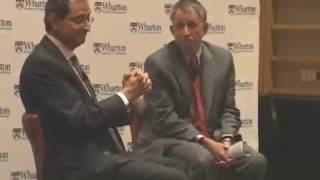
these leaders thank you very much an for
00:00:38
that very kind introduction uh Nandan
00:00:40
welcome to uh Warton India economic
00:00:42
Forum very happy to have you here thank
00:00:44
you mul it's great to be here uh so
00:00:46
before we start talking about your book
00:00:48
which is 531 Pages we'll try and cover
00:00:52
it in 20 minutes uh I just wanted to
00:00:55
tell you a small incident that happened
00:00:57
the first time that I visited infosis I
00:00:59
had come to meet one of your colleagues
00:01:01
MH and it just so happened that the week
00:01:04
before I came to Bangalore I was in
00:01:08
Bombay where my mother lives and one day
00:01:10
as I was walking about at night I
00:01:12
stepped into a pothole and I fell
00:01:14
down and as you know I'm not a very
00:01:18
light guy so I I fell on my hands and
00:01:22
fractured my Wrist all right so when I
00:01:25
came to infosis and met your colleague
00:01:28
he saw that I had a cast on my right
00:01:30
hand he said what happened to you and I
00:01:32
said I fractured my
00:01:34
wrist how did that happen said I said I
00:01:39
think it happened because the world is
00:01:40
not
00:01:42
flat I asked him to pass on that message
00:01:45
to you I don't know if he did he didn't
00:01:46
mention okay all right all
00:01:50
right anyway uh from uh Thomas
00:01:54
freedman's book to your book uh I I I I
00:01:59
I should start by saying that it's I I
00:02:01
really really enjoyed it very much oh
00:02:02
that's great uh but I was very curious
00:02:05
about one thing you know when normally
00:02:07
when company CEOs or chairman or
00:02:09
co-chairman write books they tend to
00:02:12
write either about their biggest
00:02:14
deals or they write about their
00:02:17
perspective on management Theory or
00:02:19
philosophy you wrote a book about India
00:02:23
why well uh you know I I I wanted to do
00:02:27
something different and uh you know my
00:02:30
role in the last several years has been
00:02:32
going around the world and uh uh you
00:02:34
know projecting India in in global
00:02:37
forums and all that and uh you know I
00:02:40
was not able to answer a lot of
00:02:41
questions that people would ask me they'
00:02:43
ask me why why is it that you have uh
00:02:46
such beautiful campuses like infosis and
00:02:48
such large slums why is it that there
00:02:50
are so many billionaires and so many
00:02:52
poor people why is it that uh you have
00:02:55
all these educated people in technology
00:02:57
and the world's largest elited
00:02:59
population you know why is it that you
00:03:01
you guys seem to coexist in the 17th
00:03:03
century and the 21st century at the same
00:03:05
time so that s of and I was not able to
00:03:08
give very convincing answers so I felt I
00:03:10
needed to get down to the bottom of why
00:03:12
why why are we the way we are the other
00:03:15
important thing I felt was that uh uh
00:03:18
India was you know at a very small
00:03:20
window of opportunity it had this huge
00:03:22
demographic dividend and this young
00:03:24
population but uh you know that
00:03:26
demographic dividend could well become a
00:03:28
demographic disaster if we didn't make
00:03:29
the right investments in our human
00:03:31
capital and I felt that window of
00:03:33
opportunity was ebbing by so I felt the
00:03:35
need to put it down and say hey guys you
00:03:37
know we have this beautiful opportunity
00:03:39
let's not mess with it and also I found
00:03:42
that a lot of books on India were
00:03:43
written from a particular perspective
00:03:45
and E Economist view or a sociologist
00:03:47
view I felt that to really get give
00:03:49
India its due you had to take a much
00:03:51
more holistic look at it which is why I
00:03:54
looked at it from all these angles I
00:03:56
interviewed 126 people wow including
00:03:58
people from IC Bank mhm and uh uh it's
00:04:03
really a sort of a composite of all that
00:04:05
right well uh well it clearly shows uh
00:04:08
one thing I wanted to ask about the
00:04:10
introduction is you say that the most
00:04:11
important driver for growth lies in
00:04:14
expanding access to resources and
00:04:16
opportunity as you just said now what do
00:04:19
you see as the major barriers that block
00:04:21
this access for millions of Indians and
00:04:23
how do you think they can be removed
00:04:25
well one one clear barrier to access is
00:04:27
education I mean if if you you know the
00:04:29
the opportunities for somebody say who
00:04:31
lives in Bangalore and goes to an
00:04:32
English medium school and goes to IIT is
00:04:34
dramatically different from a young
00:04:36
child in a Bihar Village who doesn't
00:04:37
have a school in his village and
00:04:39
therefore access to education and
00:04:41
providing good education in the public
00:04:44
Space is really very important second is
00:04:46
access to English you know we have
00:04:49
really practiced very hypocritical
00:04:51
policies on English we have denied
00:04:52
English to Our People and therefore they
00:04:55
have not learned English and English has
00:04:57
become the language to participate in
00:04:58
the global economy or it's access to
00:05:01
roads you know if if you live in a
00:05:02
village and you need to go to go to
00:05:04
school you need to have a road to go to
00:05:05
school or you need lights at night to
00:05:07
study very simple things so if you deny
00:05:09
people these basic instruments of
00:05:11
Education Health infrastructure jobs
00:05:14
then you are bound to deny them access
00:05:16
to building a better life I think I I
00:05:19
agree with you completely you know
00:05:21
knowledge at w is a Chinese Edition and
00:05:23
uh once when I was in China I I met
00:05:25
somebody there who has a very fast
00:05:28
growing business teaching the Chinese
00:05:29
English I was happy to know he was a
00:05:31
Barton Alam right uh the uh uh well uh
00:05:36
coming back to the phrase you used the
00:05:38
uh ear a little earlier the the
00:05:40
demographic
00:05:41
dividend uh it's very interesting that
00:05:44
in the' 60s the India's population was
00:05:47
seen almost as a burden uh but now you
00:05:50
use the term human capital uh you know
00:05:52
to to describe uh India's population uh
00:05:56
how do you think that uh the Democrat uh
00:05:59
the demographic dividend divides across
00:06:01
the country is is it in the same Pace or
00:06:04
are the regional differen there are
00:06:05
three or four things here one is that uh
00:06:07
you know we have you know a demographic
00:06:09
dividend is typically a point in a
00:06:10
country's history when the bulk of its
00:06:13
population is in the working age of 15
00:06:14
to 65 and therefore they have a very low
00:06:17
dependency ratio in other words they
00:06:18
support less people and have more people
00:06:20
to work and that's typically the Golden
00:06:22
Age of Any Nation because you have more
00:06:24
people working you have more creativity
00:06:26
and so on and India is very fortunate to
00:06:28
be having its demographic dividend now
00:06:30
and it's the only country in the world
00:06:31
which will have its demographic dividend
00:06:33
so it's not only a young country with a
00:06:34
dividend it's a young country in an
00:06:36
aging World which opens up even more
00:06:38
strategic possibilities uh but actually
00:06:41
India's demographic divid is not one
00:06:42
curve there are two curves there's one
00:06:45
curve which was in the South and the
00:06:46
west of India which is almost fully
00:06:48
absorbed by 2015 the South and the West
00:06:51
will start uh aging and there's a second
00:06:54
curve which is in Middle India the
00:06:56
central states of up Bihar chhattisghar
00:06:58
orisa all Madia Pradesh and that is
00:07:01
going to be the real demographic the
00:07:03
next the next demographic bubble so
00:07:06
unless we address very fundamental
00:07:07
issues in that region of education and
00:07:10
access and all that that that's really
00:07:12
going to be a big challenge because
00:07:13
today you see for example so many
00:07:15
problems of uh migrant workers coming to
00:07:17
Mumbai and and the reaction to them what
00:07:20
you're seeing is really a small part of
00:07:21
what will happen if we don't address
00:07:23
this very quickly because in the years
00:07:25
from 2001 to 2025 only 12.6% % of the
00:07:30
new population in India is going to be
00:07:31
in the South 50% is going to be in the
00:07:33
northern states so there's a huge you
00:07:36
know difference because fertility rates
00:07:38
in Kerala today are like a West European
00:07:41
country you know it's some onethird of
00:07:43
what it is in utar Pradesh so we have to
00:07:45
understand these nuances of what's
00:07:46
happening to really think of what we
00:07:48
need to do and how do you think the
00:07:50
second bubble can be addressed you know
00:07:52
it has to be addressed by expanding
00:07:54
access to that young population uh it's
00:07:57
about you know improving the quality of
00:07:59
school it's about better infrastructure
00:08:01
it's about job creation there as opposed
00:08:03
to job creation by migration and uh you
00:08:06
know all these things we don't have much
00:08:08
window we have window of maybe four five
00:08:10
years to pull it off right because
00:08:12
otherwise the pressure of uh the
00:08:14
disparities will will go up even further
00:08:17
right you know very much like the issue
00:08:19
of the population where there's almost
00:08:21
been a sea change uh in the way the
00:08:23
country has t about this issue which you
00:08:27
address in the first part of your of
00:08:28
your book uh the other issue like that I
00:08:31
felt was the the assumption that was
00:08:33
made soon after Independence that India
00:08:35
needs a democratic socialism you and and
00:08:38
you you say in your book that there has
00:08:40
been a similar transformation in that
00:08:42
thinking with much more accept
00:08:44
acceptance of business friendly policies
00:08:47
and and and capitalist policies uh but
00:08:50
now when you come to a place like the US
00:08:52
and you look at the mess that's going on
00:08:54
out here MH and people talking about
00:08:58
nationalizing ing Banks like City Bank
00:09:01
and Bank of America do you think this is
00:09:04
the kind of capitalism what kind of
00:09:06
capitalism does I think the the message
00:09:08
in that is that uh you know I think what
00:09:11
we need to find the right balance
00:09:12
between markets and regulated Society
00:09:14
because if you have markets which are
00:09:16
unregulated and untrammeled and then
00:09:19
they it can lead to a situation where
00:09:21
they create you know the kind of
00:09:23
challenges we have in the US and then
00:09:25
you have the reaction to that which you
00:09:26
are seeing today so I think the the
00:09:28
challenge is to find the right balance
00:09:29
and I think uh India has the opportunity
00:09:32
to find the right balance because we had
00:09:34
wear too much to to one side it doesn't
00:09:36
mean that we wear too much to the other
00:09:38
side but strike the right justos of uh
00:09:42
entrepreneurship business and the
00:09:43
markets because at end of the day you
00:09:44
need Market forces and entrepreneurs to
00:09:47
create jobs to create Innovation to
00:09:49
create new products and services to
00:09:51
improve productivity to improve the
00:09:52
quality of life and so on so you know
00:09:54
you can't do that with the state but you
00:09:56
need the state to create a regulatory
00:09:57
and other Frameworks and rule of law to
00:09:59
ensure that businesses play within
00:10:01
within the same play pen so I think
00:10:04
that's the message from what's Happening
00:10:06
Here and I think in India India is very
00:10:08
fortunate that it has I believe the
00:10:10
largest array of entrepreneurs anywhere
00:10:12
in the world except the US you know we
00:10:15
have uh large companies uh in the uh in
00:10:18
the family sector we have large
00:10:19
companies in the public sector we have
00:10:20
large global companies and we have
00:10:22
thousands of young entrepreneurs so it's
00:10:25
a very diverse and Rich uh base that we
00:10:27
need to take advantage of right
00:10:30
absolutely uh you the other really
00:10:32
fascinating part of your book uh that I
00:10:34
found was how you talk about the the
00:10:37
impact of technology in transforming
00:10:39
different Industries and also the growth
00:10:41
of India's it sector uh in providing IT
00:10:44
services and BPO services to the world
00:10:49
now amid all this success story Along
00:10:52
Comes satam which probably happened
00:10:55
after your book was done what sort of an
00:10:58
impact has that had is a specific case
00:11:01
of fraud it happened to be somebody who
00:11:06
was in the it sector who also got into
00:11:08
some real estate activities so it was a
00:11:10
case of fraud I don't think it anyway
00:11:12
takes away from the enormous uh success
00:11:15
of what technology has done to Indian
00:11:16
economy and Society now Tom fredman in
00:11:19
the blur to your book calls you the
00:11:21
great explainer what I'm what I hoping
00:11:24
you will explain to me because I don't
00:11:26
understand is is how such a huge fraud
00:11:28
could go on for such a long time uh and
00:11:31
and when you talk to your clients do
00:11:33
they see this as an isolated instance or
00:11:36
is Indian business being T no I think
00:11:39
absolutely it's seen as an isolated
00:11:40
instance because uh it's a case of one
00:11:43
uh one uh entrepreneur going erant and I
00:11:47
think uh I think it's I guess it's all
00:11:50
part of what happens in in in in a
00:11:51
bubble in some sense I mean Bernie mov
00:11:54
$50 billion scam nobody seemed to know
00:11:55
about it and some very very influential
00:11:58
and knowledgeable people seem to have
00:11:59
put money there so you know it's
00:12:01
difficult to say where where you draw
00:12:02
the line on these things right so I
00:12:04
think uh it was an unfortunate episode
00:12:06
because we have been trying to project
00:12:09
India's entrepreneurs as the new phase
00:12:12
of India and this this incident you know
00:12:15
took us back because the whole argument
00:12:17
was predicated on the statement that
00:12:19
these were you know good honest
00:12:21
entrepreneurs so it was definitely a
00:12:23
very uh you know sort of setback for the
00:12:27
Indian image you want to build but it's
00:12:29
defitely very much uh an isolated
00:12:31
instance I think uh you know we we have
00:12:34
excellent companies today in India which
00:12:36
are and I think the technology story is
00:12:38
huge because you know people tend to see
00:12:39
the technology story as the stuff which
00:12:42
is to do with Outsourcing which is a h
00:12:45
achievement but how technology has been
00:12:47
used within the country is an equally
00:12:49
compelling Story I mean the fact that
00:12:51
you have an election coming up next
00:12:52
month with 700 million voters and 1.1
00:12:55
million voting machines which are all
00:12:56
electronic there's no other country in
00:12:58
the planet which has has gone to
00:13:00
completely electronic way of voting you
00:13:02
know what people like IC Bank have done
00:13:04
using technology I've given many case
00:13:06
studies in my book they transformed the
00:13:08
way the common man gets access to
00:13:09
banking because the poor can go to an
00:13:11
ATM and withdraw money and there's no
00:13:13
Clerk and there's nobody who can come in
00:13:14
the way so I think technology has played
00:13:17
a huge role not only in the ex external
00:13:20
side but also
00:13:21
domestically now
00:13:23
uh uh I'm very glad you brought up the
00:13:26
election because towards the end of the
00:13:28
book you focus on the big issues of the
00:13:31
environment Health Care education and
00:13:34
for all this to continue the you you
00:13:36
need government Buy in to to to make
00:13:39
these uh goals succeed uh based on that
00:13:42
what's your prediction about what's
00:13:44
going there's an election coming up in
00:13:45
April uh who what do you think is going
00:13:48
to happen and will India move ahead or
00:13:51
will India fall back well I have no clue
00:13:54
what will happen in the elections
00:13:56
so you must be think have some scenarios
00:13:58
in mind if if uh Congress wins a BJP
00:14:02
wins a mayavi becomes prime
00:14:07
minister well you know even if I have
00:14:10
scenarios I don't think I'm going to
00:14:11
talk about them in this forum fair
00:14:13
enough we'll but but I think I think the
00:14:15
basic thing is that you obviously are
00:14:17
going to see a continuing Coalition and
00:14:21
and this confusing environment and
00:14:22
that's why and my point is therefore the
00:14:24
only way to drive unity in this is to
00:14:27
have a Unity of ideas and that's what
00:14:28
I'm trying to do that's why I call my
00:14:29
book a safety net of ideas if you can
00:14:31
get more people to bind to these basic
00:14:33
ideas it doesn't really matter what
00:14:35
combination comes into Power you know
00:14:37
the the infrastructure section of your
00:14:39
book is also really interesting and
00:14:41
there the question I thought about was
00:14:45
there's so much to despair about as far
00:14:46
as infrastructure goes but in
00:14:49
telecommunications infrastructure has
00:14:50
worked extremely well are there any
00:14:52
lessons from the Telecommunications
00:14:54
experience I think I think couple of I
00:14:56
mean Telecom is a huge story I today we
00:14:58
talking about 8 million mobile phones a
00:15:00
month 99% of the mobile phones are
00:15:02
prepaid which means they're being taken
00:15:03
by people who don't have a credit
00:15:05
history and 40% of the prepaid charge is
00:15:07
less than 10 Rupees a pop which is a
00:15:09
phenomenal achievement of really
00:15:11
creating a mass movement I think part of
00:15:14
it was you know the regulatory
00:15:15
environment being uh changed I mean
00:15:17
there are some challenges there but
00:15:18
still it it is trying to create a
00:15:21
playing field between both public and
00:15:23
private money and also I think
00:15:24
technology played a big role because you
00:15:26
know you had a huge M law kind of thing
00:15:28
operating there
00:15:29
and uh uh but I think there other
00:15:31
sectors too where infrastructure I mean
00:15:33
uh airports are coming up the Bangalore
00:15:35
airport has come up the Hyderabad
00:15:37
airport has come up Bombay and Delhi are
00:15:39
getting redone the highways of course it
00:15:41
did slow down a bit but there's been a
00:15:43
lot of movement on highways it's I mean
00:15:44
I the challenge we have it's nowhere on
00:15:46
the scale and scope of China so we tend
00:15:48
to compare but I do see a lot of
00:15:49
improvements in
00:15:50
infrastructure uh I'd like to ask one
00:15:53
last question and then turn it over to
00:15:55
the to the audience uh since your book
00:15:57
is imagining India
00:15:59
what kind of an India would you imagine
00:16:02
for your grandchildren and their
00:16:03
children well I think you know my point
00:16:06
in this book is to say that India is at
00:16:09
a strategic opportunity it's combination
00:16:11
of its demographics its entrepreneurs
00:16:14
it's its technology press it's uh
00:16:18
democracy the fact that the world is
00:16:20
aging while we are young uh the fact
00:16:22
that we have English as a language all
00:16:24
these are very unique attributes that
00:16:26
there's no other country in the world
00:16:28
which has those
00:16:29
and if we make the full use of that I
00:16:32
think it can become a role model for the
00:16:34
21st century because you're talking
00:16:35
about a billion people reaching
00:16:37
Prosperity reaching uh you know living
00:16:40
in a peaceful manner in a democracy
00:16:42
handling extraordinary diversity I mean
00:16:44
the whole issue today of so-call clash
00:16:45
of civilizations India has daily you
00:16:48
know all those civilizations are all
00:16:49
coexisting so I think the ability to
00:16:51
show this combination of development
00:16:53
diversity democracy will really make it
00:16:56
a very very successful country if you do
00:16:58
it right but it can also go the other
00:17:00
way because the same demographic
00:17:01
dividend if you don't harness our people
00:17:03
well their aspirations have been
00:17:05
Unleashed and as they become more
00:17:07
disgruntled and disaffected by lack of
00:17:09
jobs and lack of economic growth they
00:17:12
can also become a huge source of
00:17:13
violence and divisiveness so we are on
00:17:15
the razor's Edge whether we go this way
00:17:17
or that way well it's definitely very
00:17:19
compelling argument and you make it
00:17:20
extremely well
00:17:23
[Music]