00:00:01
[Music]
00:00:12
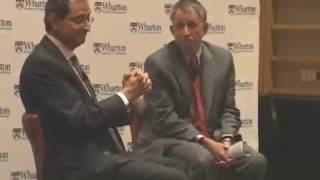
The 2009 Wharton India Economic Forum
00:00:15
titled India: The Road Ahead took place
00:00:18
in Philadelphia and brought together
00:00:20
CEOs of leading Indian companies,
00:00:22
investors, heads of nonprofit
00:00:24
organizations, sports celebrities, and
00:00:27
Bollywood stars to discuss where India
00:00:29
is headed. In an age of economic
00:00:31
uncertainty, Indian Knowledge at Wharton
00:00:33
brings you one-on-one conversations with
00:00:35
these leaders.
00:00:37
Cara, thank you so much for joining us
00:00:38
today.
00:00:39
Thank you. So much has been written
00:00:41
about the world financial crisis and the
00:00:45
uh recession, the greatest crisis since
00:00:47
the great depression. Uh how do you
00:00:49
think it has affected uh the Indian
00:00:52
economy and the people of India?
00:00:56
Um I don't think it's really affected uh
00:00:58
the Indian economy and and the and the
00:01:02
billion 1.2 billion people of India. Um
00:01:04
it's what's really happened is that uh
00:01:07
suddenly um demand has fallen in India
00:01:10
partly because of domestic reasons and
00:01:12
partly because exports are down because
00:01:14
there's no foreign demand or reduction
00:01:17
in foreign demand and that has its sort
00:01:19
of multiplier effect in the whole Indian
00:01:21
economy. So just like the rest of the
00:01:23
world that seems to have fallen off a
00:01:24
cliff in the last 6 to 8 months. Uh it
00:01:27
was certainly falling but in the 6 to 8
00:01:29
months I think the drop has been
00:01:31
incredibly um steep. I've never seen
00:01:34
anything like this in my uh pretty long
00:01:37
career now. Um and so it is worrying
00:01:39
because we don't know where we are all
00:01:41
going and that means not only the
00:01:43
western developed world or it also means
00:01:45
India and other developing countries
00:01:47
because we've never had a situation of
00:01:49
this this magnitude before but India
00:01:51
being self-sufficient in so many things
00:01:53
it's really a self-contained economy we
00:01:56
depend on world trade for just about I
00:01:58
think uh I may not have my figures quite
00:02:02
accurately but about 20 to 23% um of the
00:02:05
Indian GDP is accounted for by foreign
00:02:08
trade. So 75% of the country or of our
00:02:12
business
00:02:14
business oriented GDP, agriculture and
00:02:16
so on is insulated and is not really
00:02:18
affected and our banks are pretty
00:02:21
solvent. Uh uh they've not had the uh uh
00:02:25
NPA or non-perform performing assets
00:02:27
which western banks have had. We've had
00:02:28
our own problems with non-performing
00:02:31
assets, but they've been minor. A bit in
00:02:33
property, a bit in car loans, personal
00:02:35
finance, things of that nature, but
00:02:36
nothing of the magnitude where you you
00:02:39
have banks that need to be nationalized
00:02:41
or or saved or or rescued. Um, so I
00:02:46
think India has been pretty well
00:02:47
insulated and we hope that it can
00:02:49
continue to be. So, and I think the
00:02:51
government of India has followed a
00:02:52
sensible policy and not panicking.
00:02:54
They've also
00:02:57
loosened the taps on money supply to a
00:03:00
considerable extent. So industry has
00:03:03
enough finance available. A lot of us
00:03:05
complain about it because it's uh uh
00:03:07
it's nice to complain and to egg the
00:03:09
government on uh to loos to open up the
00:03:12
taps further which is going to be
00:03:14
necessary. And I think just like the
00:03:15
United States um uh you you've got to
00:03:18
take a long-term view on this. Yes,
00:03:20
you're uh letting money supply expand
00:03:23
dramatically uh through a whole series
00:03:25
of measures, but u and that it may
00:03:29
create inflation in the long run. Yes,
00:03:31
that's probably a given, but we see no
00:03:33
signs of that yet. So, let's worry about
00:03:36
perhaps a lesser problem then than worry
00:03:38
about it right now. And I think the
00:03:40
problem now is to get the world economy
00:03:42
going, to get our own domestic economies
00:03:44
going, but in a sensible balanced way.
00:03:46
None of the excesses that we've seen in
00:03:50
in the past decade or so both uh
00:03:52
overseas and even in India and for
00:03:54
example I think the excesses in the
00:03:56
property market
00:03:58
for example and even in the stock market
00:03:59
you know valuations had reached
00:04:01
ridiculous levels um and uh uh and and
00:04:06
and a reaction was bound to happen.
00:04:08
What about the insurance market has that
00:04:10
been affected at all? The insurance
00:04:11
market has only been affected I think uh
00:04:14
in terms of people going a bit slow on
00:04:17
using their savings u to put into other
00:04:21
types of savings. Insurance is also a
00:04:23
type of saving. If you if you're just
00:04:24
taking plain u simple life cover that's
00:04:27
not a saving. That's just pure
00:04:29
insurance. But there are schemes which
00:04:31
are attached to perhaps investment
00:04:33
schemes, debt schemes, equity schemes,
00:04:35
mix schemes. Um and people are slowing
00:04:38
down on on that for sure. Right. I I
00:04:41
know that the Tata group has been
00:04:42
involved with AIG and I and I wonder if
00:04:45
uh AIG's problems with uh the subprime
00:04:49
crisis in the US has had any effect. In
00:04:51
fact, it be very helpful to understand
00:04:53
the a Tata AIG venture and and to see
00:04:56
whether it has been an effect.
00:04:58
Okay. Uh I won't obviously uh speak
00:05:00
about AIG per se and the problems that
00:05:03
it faces in the United States. It would
00:05:05
be wrong for me to comment on that. uh
00:05:07
but certainly in terms of our joint
00:05:09
venture in India um it's a joint venture
00:05:13
two joint ventures one on the life side
00:05:14
and one on the general side general
00:05:17
being non-life you know fire property
00:05:19
casualty um and both uh companies have
00:05:23
an equity holding uh from AIG of 24% and
00:05:27
Tata Suns of uh uh 20 of 74%
00:05:31
sorry did I say 26% yeah 26% and uh
00:05:35
Tatas of 74% so We have a majority
00:05:37
holding and we and the the capital is uh
00:05:40
the companies are properly capitalized.
00:05:42
They are properly regulated by the
00:05:44
insurance um regulator. We meet uh um
00:05:50
solveny norms um far beyond what the
00:05:53
regulator requires. The normal
00:05:56
regulation says that you must have 150%
00:05:58
uh solveny ratio. We are in the life
00:06:01
company probably nearer 300%
00:06:05
and the or sorry perhaps 250% uh and in
00:06:09
the general company 200%. So we are well
00:06:12
capitalized. There's nothing to worry.
00:06:14
In fact uh uh we've been very very uh uh
00:06:18
happy at the response that we've had
00:06:20
from our existing policy holders uh
00:06:22
because as far as they are concerned
00:06:23
they see the Tata name. The EIG name may
00:06:26
be known significantly in
00:06:30
in the western world or in other
00:06:31
countries. Uh it's not it's relatively
00:06:33
unknown. EIG's made a good uh start at
00:06:36
building their brand in India. Uh
00:06:38
unfortunately these events have happened
00:06:40
over the last 69 months uh which may um
00:06:44
leave them bit bruised and damaged. Uh
00:06:46
but it but has been a great
00:06:48
international name. So we've had no
00:06:50
problems with our AIG partnership as
00:06:53
such. They brought a lot of domain
00:06:54
knowledge to the business. We brought in
00:06:57
local knowledge. We brought in uh local
00:06:59
local uh u marketing u
00:07:04
in-depth marketing skills uh which I
00:07:06
believe make for a successful
00:07:09
combination. In fact, maybe a lot of
00:07:11
people don't know but before uh um the
00:07:15
insurance industry was nationalized uh
00:07:17
Tatas had an insurance company in in its
00:07:20
fold called the new India insurance
00:07:21
company. It was founded by um sir I
00:07:24
think it was sir doruptata um and in the
00:07:28
1930 it was founded in the 1930s and at
00:07:30
the time of nationalization in the 60s
00:07:32
and on the bout of nationalization in
00:07:34
the 70s we were the largest private
00:07:37
sector insurance company
00:07:39
so we have some background uh some
00:07:42
legacy uh the saying we just tried to
00:07:45
reclaim our legacy
00:07:46
right and I know in the course of your
00:07:49
career with the Tatas you've also been
00:07:50
involved with Tata motors
00:07:52
which which has been in the news quite a
00:07:54
bit. Uh I believe the Nano is uh you
00:07:57
know about to be launched relatively
00:08:00
soon. Uh given the auto uh auto crisis
00:08:04
in the US, I wonder how you see the
00:08:07
source of the crisis here and whether
00:08:09
you know the Tata's expertise in the
00:08:11
auto industry might offer any lessons.
00:08:15
that would be a bit presumptuous to
00:08:16
offer something to the United States.
00:08:18
But uh but anyway firstly in terms of
00:08:22
the the nano yes it is going to be
00:08:24
launched uh in 2 days uh on the 23rd of
00:08:26
March uh uh in moment and by launching
00:08:29
it means it's really going to be
00:08:30
available uh for the general public to
00:08:33
start bookings and uh hopefully
00:08:35
deliveries. The original plan was of
00:08:37
course that we would uh be starting off
00:08:39
from a single mother plant um in Singur
00:08:42
and uh we would have been uh we would
00:08:44
have had nanos um in the streets of
00:08:47
India or roads of India on the roads of
00:08:49
India um 6 months ago. Uh but these
00:08:52
delays have happened now we using other
00:08:56
plants uh in in in in Tata Motors to
00:08:59
produce the nano and the production
00:09:02
scales won't be very large to start off
00:09:04
with. uh but as soon as the uh plant in
00:09:06
Gujarat and SAN becomes available uh and
00:09:10
is fully geared up with equipment and
00:09:13
commercial runs have happened then I
00:09:15
think uh we'll see some volume sales.
00:09:17
Do you think you might ever sell the
00:09:19
Nano in the US?
00:09:20
I would say not for the foreseeable
00:09:22
future. It's difficult to say never uh
00:09:24
or shouldn't one should never say never.
00:09:26
Um but I think it's it's unlikely that
00:09:28
the United States would be on our
00:09:31
priority list. Certainly Europe would be
00:09:32
on a on our priority list. Um and again
00:09:35
when I say priority list I'm talking of
00:09:38
say 3 years ahead 3 years from now. By
00:09:40
the way I'm no longer associated with uh
00:09:43
Tata Motors directly. Uh but at the
00:09:46
group level whatever is public knowledge
00:09:48
or semi-public knowledge I can perhaps
00:09:50
share with you. But Mr. Tata himself at
00:09:52
the Geneva Motor Show made a public
00:09:54
statement, I believe, um that the Nano
00:09:59
he hoped would be available in Europe at
00:10:02
a reasonable time in the future. When he
00:10:04
was pressed, he said maybe 3 years. Um
00:10:06
and um and again, somebody asked, would
00:10:10
it really be $1,000 uh sorry, a $2,000
00:10:13
car? Um um and he said no I don't think
00:10:17
so because we'd have to meet uh as it is
00:10:20
it meets pretty stringent uh safety
00:10:23
norms in India um and and in fact for
00:10:28
Europe the norms today are not very
00:10:29
different from the Indian norms but in
00:10:32
the expectation that be higher norms as
00:10:35
we go along three years he thought was a
00:10:37
good enough period in which to get the
00:10:38
nano up to European standards for sure
00:10:41
and the price again he was pressed on
00:10:44
and he said, "Well, if you want me to
00:10:46
give you an approximate price, I'd say
00:10:47
it's probably $5,000."
00:10:50
Over the course of your career, what
00:10:52
would you say is the biggest leadership
00:10:54
challenge you've ever faced and how did
00:10:57
you overcome it and what did you learn
00:10:59
from it?
00:11:01
Well, I think you you face problems and
00:11:04
crises all the time. So I I wouldn't
00:11:07
pick any particular one but I'd just say
00:11:09
that uh we went through a very difficult
00:11:11
time in Tala Motors um in uh
00:11:15
soon after we launched the Indicar um
00:11:19
when which was India's first really um
00:11:23
domestic domestically designed and
00:11:25
engineered and manufactured car um and
00:11:28
it was not a creation of the car's
00:11:30
problems. It was a creation of demand.
00:11:33
demand just collapsed in the uh in in in
00:11:36
in the economy. So it affected the truck
00:11:39
business and Tata Motors at that time
00:11:42
was really a truck company. It's now
00:11:44
that it can proudly say it's also a car
00:11:46
company but at that time it was very
00:11:48
much a truck company and we were
00:11:49
undergoing the transformation into being
00:11:51
an automobile company also by creating a
00:11:53
separate uh vertical in our organization
00:11:56
but to change the mindset of people uh
00:11:59
to go from a truck manufacturing uh
00:12:02
manufacturing and quality uh mindset to
00:12:05
a car thing was probably the key and u I
00:12:08
bore the brunt of it because uh not that
00:12:12
I was involved in manufacturing ing at
00:12:13
all or quality. But because I was in
00:12:15
charge of my my executive directorship
00:12:19
contained one uh u one area and that was
00:12:23
overseas exports or business overseas
00:12:27
whether it was exports or local assembly
00:12:30
plants things of that nature and the key
00:12:32
problem was quality um and uh and I
00:12:35
think uh Mr. started recognized that uh
00:12:38
uh at that time straight away that uh we
00:12:40
had to improve the quality and so we
00:12:41
decided to to cut down our exports until
00:12:44
we got our quality right and in certain
00:12:46
markets uh because you see we had this
00:12:48
great dream uh that yeah with with the
00:12:50
indica it's again a bit like the Nano
00:12:52
it's it was going to be a cheap uh cheap
00:12:55
only in terms of price uh but value for
00:12:57
money car uh the Nano today is you know
00:12:59
everybody keeps calling it the cheapest
00:13:02
uh car in the world but I I would rather
00:13:04
call it the least expensive in the world
00:13:06
and it's going to deliver real value for
00:13:08
money. Uh because again to come to the
00:13:10
narrow for a quick second contrary to
00:13:13
everybody's views that oh it's just a
00:13:15
rick shaw or uh something like that with
00:13:17
paneling. No, it's really a full-blooded
00:13:20
car. It's no different from we joked
00:13:22
about it earlier about the folkswagen.
00:13:24
Uh when I bought a folkswagen here uh
00:13:27
was it you or somebody else? No. Sorry.
00:13:29
Okay. Um as a student for $2,000 at that
00:13:33
time. Uh so we reverting back to a
00:13:36
$2,000
00:13:37
uh car u but a modern car uh but a
00:13:41
smaller engine of course uh but uh but
00:13:43
the price of the dollar has fallen
00:13:45
considerably uh so in effect it's an
00:13:47
even more efficient and a much greater
00:13:49
value for money car uh today and so the
00:13:52
quality issue I would say u
00:13:55
data motors was uh was was a major issue
00:13:58
and then of course the recession hit us
00:14:00
very badly so uh the the car side was
00:14:03
being supported for a while in its
00:14:04
infancy by the truck side of the
00:14:06
business in terms of uh profitability
00:14:09
and revenue. Uh and uh uh so it's a bad
00:14:12
time those two years but we came out of
00:14:14
it very well. the economy revived. You
00:14:16
know, it's in the automobile industry,
00:14:18
it cycles. And then the lesson to be
00:14:21
learned really is that you don't
00:14:23
overbuild capacity, just an expectation
00:14:25
that it's going to be a vertically
00:14:27
rising market and that you've had four
00:14:29
good years. So therefore, the next four
00:14:31
years are also going to be good and the
00:14:32
four years after that. So all you do is
00:14:35
just say it's a five to six year cycle
00:14:37
and just plan for that. And in in the
00:14:39
recessionary conditions then you start
00:14:41
maybe putting up capacity which will
00:14:43
meet the demand when the next boom
00:14:45
starts. Uh but uh but but this is a
00:14:48
mistake that we all make and we really
00:14:49
started expanding our capacity. So we
00:14:51
had a big financial crunch. Uh
00:14:54
one last question. I I know that uh one
00:14:57
of the things that concerns you a lot is
00:14:59
the problems that India faces. uh with
00:15:02
of all the problems that the country has
00:15:05
uh which are are you uh which do you
00:15:09
regard as the as as the uh ones that
00:15:12
affect you most personally and and what
00:15:14
do you think can be done about them?
00:15:17
I certainly think uh I mean it's it's
00:15:19
you know poverty defines a whole host of
00:15:21
things. So poverty whether it's poverty
00:15:24
of uh u of of one's lifestyle or or or
00:15:29
the basics of life poverty of education
00:15:32
posity of uh you know basic electricity
00:15:35
availability of electricity to live uh
00:15:38
comfortably or use any any equipment the
00:15:42
the whole manufacturing side of our
00:15:44
industry so it's all interlin um I I
00:15:47
would say that u today if one can
00:15:50
alleviate
00:15:52
basic human poverty and misery in India
00:15:55
through whatever means it doesn't matter
00:15:56
even if the government gives out massive
00:15:58
dos but if it reaches the poor and they
00:16:01
have the ability then to spend it on
00:16:02
useful things and it doesn't mean that
00:16:04
uh suddenly the village girls start
00:16:07
applying lipstick and uh things of that
00:16:10
nature but it's used in in a in a in a
00:16:13
focused way um and and there's hunger in
00:16:16
India it's not as if there's no hunger
00:16:17
in India yes we've had a wonderful food
00:16:20
revolution and a milk revolution and uh
00:16:23
all these things we are supposed to be
00:16:24
self-sufficient um
00:16:27
in food grains but real the reality is
00:16:29
that it doesn't go down to the masses
00:16:33
and that 2/3 that's in the villages or
00:16:35
in
00:16:37
in fact in the slum dog millionaire film
00:16:41
slums of Bombay Daravi and so on it
00:16:43
doesn't reach them but it reaches them
00:16:45
because they are trying striving to get
00:16:46
out of it they are working harder
00:16:49
they've got the willpower they've got
00:16:50
the
00:16:52
And I think just like those two kids,
00:16:56
they'll do they'll win it.
00:16:58
Thank you so much for joining us today.
00:17:00
Appreciate it.
00:17:00
Thank you.
00:17:03
[Music]