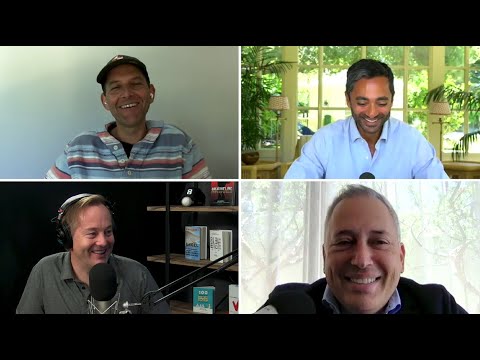


00:00:00
all right everybody welcome to another edition
of the all-in podcast we'll call this episode
00:00:05
one we did a test and over a hundred thousand
of you listened to the test podcast that we
00:00:11
knew the audios if you did in a few days Tomas
is already getting addicted to his statistics
00:00:15
a new podcaster Lima to focus on something going
up yes exactly our portfolios are getting crushed
00:00:24
but the podcast numbers are going up there with
a meaningless victory to be sure but we got a lot
00:00:30
of positive feedback and we're all sitting at
home in quarantine as you can see I set up my
00:00:35
home office I got our microphone here and Shema
tha's in his bedroom and dear Freiburg I think
00:00:40
is in his wine room or something in his uh in his
compound are you in the safe room is this the safe
00:00:45
room Dave Freiburg is with us again he got a lot
of great feedback and he's now on the Twitter you
00:00:50
can follow him at Friedberg I don't know if he
showed his Twitter down because he was getting
00:00:54
harassed on Twitter welcome to the club are you in
your safe room David yeah it's brutal on Twitter I
00:01:01
don't know how you guys do it you put something
up and everyone you know just goes after you
00:01:05
it's hard you out there in the Twitter world the
Twitterverse basically you have to mute and block
00:01:12
anybody who is under a hundred followers and being
an absolute jerk because it's likely a Russian bot
00:01:20
you know being run out of like Manila or something
like that they've got all these like sophisticated
00:01:25
rings of people that they just hire for ten bucks
a day to harass people online I mean I know it
00:01:32
sounds like a crazy conspiracy theory but it's
actually true this large groups of bots who go
00:01:36
after people and try to kick create chaos but okay
we're sitting here it's today's Wednesday we did
00:01:44
our podcast on Saturday the stock market has gone
down another twenty percent since then I guess or
00:01:51
so and we are looking like this is going to be a
fifty percent correction or something like that
00:01:59
we're now you know well past a 30 plus percent
and on the good news front it looks like testing
00:02:06
is actually occurring and that work on a virus
work on treatments is occurring we can call them
00:02:14
cures but treatments is occurring and quarantine
in place is being taken seriously and I guess
00:02:20
the biggest thing is that Trump has basically
admitted that this is a crisis and he's taking
00:02:25
it seriously Friedberg what is your assessment
of where we are today versus when we taped on
00:02:32
Saturday in terms of the resolution to this we
are we overreacting reacting just enough or not
00:02:39
reacting enough there's three things to consider
the health the policy and then the markets on the
00:02:48
health front it seems like we have done a lot in
terms of containment and we're ramping up testing
00:02:54
we are still not doing broad general general
population testing which is necessary for us to
00:02:59
truly understand the dynamics of this disease and
also to understand the contagion of this disease
00:03:04
and we need to fix that problem there's a task
force of a hundred people out of DC being led
00:03:10
by Jared Kushner and a number of people from
the tech industry that are working on ramping
00:03:13
up testing and doing broader general population
testing the policy decisions are what get quite
00:03:19
scary and that is all of the containment shutting
down travel shutting down borders shutting down
00:03:24
bridges and the economic ramifications of doing
so are frightening I think I mentioned the other
00:03:29
day that 48 percent roughly of the US workforce
works in small businesses another roughly 10
00:03:35
percent work in travel another roughly 12 percent
work in energy and you know you kind of add this
00:03:41
up and you can quickly see why Steve Mucha and
the US Treasury Secretary was saying that we
00:03:47
should expect 20 to 30% of the workforce to be
unemployed by this summer if we keep this up so
00:03:53
that is a frustrating and staggering statistic
and something worth debating whether that policy
00:03:57
decision is appropriate relative to the potential
life and health and and Health System impact you
00:04:05
know which one is worse and then the market
question is just I don't know how to address
00:04:10
it but things go ahead afterwards I have eight
things I want to say one more thing and it is I
00:04:25
think the most important to come out today so the
markets are [ __ ] we're all in trouble or you
00:04:29
know yadda yadda the most scary thing is Ford and
GM to shut down their plants today and the reason
00:04:35
they shut down their plants is because out of
fear of coronavirus and Auto Workers and the
00:04:40
UAW basically forced them to do it the world
lives on a 30 day food supply so if you stop
00:04:46
food production today there would only be 30 days
of food for the whole world to eat based on our
00:04:52
calorie consumption per day and especially with
an isolated border and we import a lot of food
00:04:56
in the United States if that means that we are
then going to shut down other factories the Ford
00:05:01
GM shut down and we're going to shut down food
production processing and distribution factories
00:05:06
then we have a food security crisis and this
becomes a real societal problem so the concern
00:05:12
that I have with the factories being shut down
today is the precedent it sets and the potential
00:05:16
follow-on from there in the food system and one
thing we can't stop doing is making a distributing
00:05:21
food to humans in the United States or else we are
going to have problems you're right but before we
00:05:27
go there the good news is that these directives
don't apply to national critical infrastructure
00:05:32
and the food supply is covered within that so
unless something cataclysmic happens those folks
00:05:40
are still going to make sure that food supply
is there I do agree with you that the issue that
00:05:47
we have to contend with is that you know there
may not be as much and in the you know 30th to
00:05:54
90th day that becomes a real issue if this thing
becomes a very protracted problem this sort of
00:06:00
brings us back David without being too alarmist
about how we started and how you started really
00:06:05
importantly at the beginning which is there is a
small but very credible body of evidence that is
00:06:13
starting to show and this is what you put out on
Twitter and part of why you got you know attacked
00:06:17
probably by the pharma Lobby but that shows that
there is a there is potentially an enormous ly
00:06:27
large asymptomatic spreader dynamic in this
disease so can you describe that and what that
00:06:35
may mean and why there's a lot of silver lining in
good news that if it's true there are several data
00:06:42
points that are showing us that there may be an
unexpectedly high number of people that get this
00:06:49
disease and don't have any symptoms and show it
the historical data that we've gathered to date
00:06:55
has been largely symptomatic patients and in some
places like in Korea asymptomatic patients that
00:07:00
had really close contact with symptomatic patients
that were confirmed to be positive and in Korea in
00:07:06
particular they found a large cohort nearly 40% of
the infected population were people between 20 and
00:07:13
29 years old that did not exhibit any symptoms or
had very mild symptoms had a runny nose and didn't
00:07:18
even know that they were sick on the princess
cruise ship it turns out that up to 50 percent
00:07:23
may have been asymptomatic people were all tested
on that cruise ship because there were so many
00:07:29
people that were positive and through that data
set that cohort we found a very large asymptomatic
00:07:34
population 50% roughly the NBA players have
now been tested and out of seven players on
00:07:40
five teams so out of seven players on those five
teams that have tested positive it seems like none
00:07:46
of them are having any symptoms there may be
one person who's having a cough but generally
00:07:50
they seem one of I think it was Donovan Mitchell
said I could go play a seven game series tomorrow
00:07:53
so this data is really important and it hasn't
been fully accounted for in the models and the
00:07:59
predictions of the pandemic and the predictions of
the fatality rate we're assuming that let's say 2%
00:08:05
of people that get this disease end up dying and
by the way that's also based on an age histogram
00:08:10
that may not be appropriate for our particular
cohort in the United States if you took that
00:08:14
data and then you just did it based on the fact
that a large percentage of people actually don't
00:08:18
die but they end up just being asymptomatic it
really changes the denominator and it skews the
00:08:23
results a paper published showed that in China up
to eighty six percent of people did not realize
00:08:29
that they were sick or they were unreported they
had mild symptoms if you take that high level
00:08:33
you take that low level call it somewhere between
twenty-five and eighty per se T six percent maybe
00:08:38
even as high as eighty six percent of patients are
asymptomatic which means that the actual fatality
00:08:43
rate is much much lower even in a large cohort
that gets infected here so we should be mindful
00:08:50
of this new data that's emerging and worse Racing
and acting from a policy basis as if 2 percent of
00:08:57
people 3 percent of people 4 percent of people
that get this are gonna die and that may not
00:09:01
actually be true based on what we're saying in
the last week I have a comment in a statement
00:09:05
the comment is people will say David you can't
extrapolate from an NBA player who may just be
00:09:11
in peak physical fitness although I think your
answer is going to be it's not clear that the
00:09:16
that the disease is correlated necessarily with
physical fitness for on physical fitness at all it
00:09:23
just may be the strain and how your body processes
but then the question is doesn't this mean that we
00:09:29
need to have broad-based massive testing not just
of symptomatic populations so not just the PCR
00:09:38
test that we've heard a lot about but also these
antibody tests so that we've know that people have
00:09:43
had it and what's the status of that David what's
the status evidence that that's exactly right
00:09:48
tomorrow and by the way on the healthy NBA player
point it's absolutely true people that are between
00:09:52
20 and 30 the average age in the NBA is 26 years
old people that are between 20 and 30 years old
00:09:57
generally seem to have no to mild symptoms based
on what we saw in Korea the other datasets need to
00:10:03
be taken into account so the NBA is an interesting
anecdote sure and you could discredit it all you
00:10:07
wanted saying that it's a highly correlated
class and so on because everyone's together
00:10:11
all the time but we could look at the data that
came out of China in a paper that was published in
00:10:15
the journal Science and a paper that was published
in the journal Nature from Korea that showed very
00:10:21
large percentages anywhere from 20 to 50 to 80%
or 90% of people being completely asymptomatic
00:10:27
across an age spectrum certainly very heavier
weighted towards the younger age bracket from you
00:10:34
know children all the way up to 30 or 40 years
old you can be completely asymptomatic and so
00:10:39
these are really interesting discoveries that have
happened and so to your point we need more data we
00:10:43
need to confirm that hypothesis because that's
how science works so we have a hypothesis let's
00:10:48
go test it the problem is we're not testing it
and we should be as a priority right now because
00:10:52
the policy decisions we're making are based upon
a denominator that may be wrong so the correct
00:10:57
action should be to go get those antibody tests
go out into the population and start testing the
00:11:03
unscented asymptomatic general population and see
what percentage of people in these high-risk zones
00:11:08
like Seattle and LA and New York and SF already
have the antibodies to this virus meaning they've
00:11:13
been infected with this virus and have not or
are not showing any symptoms and that gives us a
00:11:18
better sense of a how widespread this infection is
and B the true dynamics of the fatality rate and
00:11:24
the symptomology of this disease and how it may
affect the people those IgG tests are being made
00:11:29
on mass in China today they're being shipped to
countries like Italy where they are in fact being
00:11:34
used on the frontline they involve a blood draw
and then they have this lateral it's there called
00:11:38
a lateral flow assay in terms of how they're kind
of tested the blood runs across a strip and you
00:11:44
see a value and you have a pretty good sense at
that point those kits cost a couple of pennies
00:11:49
to make in China we could probably get a couple
million of them I don't understand why we're not
00:11:53
I don't understand why someone in the federal
government isn't begging China and apologizing
00:11:58
and appeasing to them to send us those kits there
are a lot of people I know that have bought them
00:12:02
on the Internet I have a bunch of people that I
know have bought them they have been shipped in
00:12:07
through brokers and they are not FDA approved they
cannot be used for diagnostic purposes because of
00:12:11
FDA guidelines that have the FDA regulates these
things they can be used for research purposes but
00:12:17
they may not be very sensitive and very specific
and they don't have great testing on them so we
00:12:21
don't estimate the sensitivity and the specificity
to be 90 percent roughly 10 percent false positive
00:12:26
roughly 10 percent false negative but for what
we're trying to accomplish that's good enough
00:12:30
we're not trying to give people a diagnosis of
disease we're trying to run an epidemiological
00:12:34
study and we should on the general population
to figure out how many people out there are
00:12:38
asymptomatic and have been infected that it's
an important statistic that's missing and to
00:12:43
your point if we find out that there is a large
population of people that have actually felt this
00:12:50
disease passed through them it's faster that
we can sort of get people back to work out in
00:12:56
the streets which is now probably going to be the
most important thing we can do to just prevent a
00:13:02
complete economic calamity yeah yeah there are
there are Jason and sorry treatments Jim ops
00:13:12
all right interrupt you but treatments are the
other thing I think you're going to talk about
00:13:15
that treatments are interesting let's talk about
that right now because to me what's incredible
00:13:19
is the again now what is emerging and and its
small and scale relative to how amplified it
00:13:26
may may should or should not be is you know Ren
des vir is very different but it just seems like
00:13:32
prophylactically even there's some data that's
showing out of France that chloroquine seems to
00:13:37
be effective these are these are solutions that
are pennies to make and some of the some of the
00:13:43
feedback that I've heard is that part of why the
FDA the CDC the the federal apparatus is reluctant
00:13:51
to embrace these things is in part because of
pressure from those lobbies but that seems to me
00:13:58
unfathomable in a moment like this so why do you
think the government hasn't put out the CDC has
00:14:05
zero directive right now on the management
and efficacious management of this disease
00:14:10
why is that okay what say you Qi and others have
said and doctors around the country echo is that
00:14:16
these treatments have not been clinically tested
through a blinded controlled study and that is a
00:14:22
very fair assertion generally speaking for doing
good medicine but we are in a crisis state and
00:14:29
in a crisis state you have to triage and you also
have to triage policy and we should be considering
00:14:35
creating policy and changing the way that we do
policy under these extenuating circumstances if
00:14:40
doing treatment can reduce fatality rates by up
to 4x as Korean doctors have claimed it is worth
00:14:47
taking the risk or perhaps it is worth letting
the FDA say renessa vehicle Etra chloroquine
00:14:54
and others are being widely produced widely
distributed the government is mandating it
00:14:58
and doctors and their patients can decide if and
when they want to use it and let them take the
00:15:03
risk without clinical trials and without data and
the typical process of the FDA what's the downside
00:15:09
of taking these drugs are they particularly
dangerous I mean I've heard the colloquy
00:15:13
gnomic perhaps incorrectly Cola quint chloroquine
I've heard that this can be a little bit nasty in
00:15:19
terms of side-effects so is there some major
downside that I mean it's kind of like an off
00:15:23
use of a drug right like this is an off use of a
drug as opposed to it's an off use of a drug and
00:15:29
some of the antivirals aren't even fully tested in
humans so we don't yet know what the side-effects
00:15:34
may be and also remember side effects can change
based upon your health condition so someone that's
00:15:40
in respiratory distress may have different side
effects than someone who's taking it in a healthy
00:15:44
controlled clinical trial so we're not really sure
that's the argument that doctors would make is you
00:15:49
know our first mandate is to do no harm and so
they don't want to apply a medicine that might
00:15:54
do harm and so that is the standard protocol and
practice and process however again in a crisis
00:16:00
state China and Korea said guys we're trying
this thing and it's working and we're adopting it
00:16:04
let's go for it and they race forward it could be
that this is a good time for the United States to
00:16:09
consider an emergency policy action where we make
a lot of this stuff make it available and simply
00:16:14
like doctors use their best judgment rather than
have the FDA be the paternal state that makes a
00:16:19
decision for the doctors or makes a recommendation
to the doctors well what do we think the fatality
00:16:26
rate actually is like David if you were looking at
this and you had to place a bat and put a hundred
00:16:34
percent of your net worth on it and be all in and
have massive skin in the game where do you think
00:16:40
the fatality rate here in the United States winds
up being overall because the data that came out of
00:16:45
Wuhan has been markedly going down as they get the
numbers corrected who knows Chinese numbers you
00:16:52
know censored by the government and maybe perhaps
massaged - it's gonna be hard to tell what do you
00:16:57
think the real fatality rate is the first fatality
rate I heard was 5.8 percent out of China though
00:17:02
based on the paper that came out in science over
the weekend the wu hand data was estimated to be
00:17:07
1.4 percent and Wu hen was the worst data out of
China the quote-unquote rest of China is still
00:17:13
estimated at about 0.15 percent or 0.1 6% 0.14
percent something like that where's that versus
00:17:19
like the flu every year or something or the normal
flu 1.1 percent roughly yeah and so you know if
00:17:25
you're looking at somewhere between 0.2 and 1.5
percent now in Italy I think they're at over 7
00:17:31
percent we talked about this on the last show
but Italy is a much older population and their
00:17:36
health system is completely overwhelmed so there's
some confounding data that's confounding variables
00:17:42
there that may be making Italy a very you outlier
on a distribution of what's gonna happen here the
00:17:48
United States has a population that's a little
bit older than China but much younger than Italy
00:17:52
so our health system is and our health system is
generally more ICU beds per capita than Italy so
00:17:58
so we should be in a better place the thing we
don't know that does concern me about the health
00:18:01
system the United States and the population in
the United States is it seems that there may be
00:18:05
a high correlation with severity of disease and
a1c levels and and as a result the US has one of
00:18:13
the highest obesity rates of any country in the
world and highest diabetes rates and so we may
00:18:17
have a population that has a very high percentage
of people with a high a1c that may be at higher
00:18:23
risk than say people in other countries I don't
know that for sure but that is those are two kind
00:18:29
of confounding statistics that may kind of make
things a little bit worse if I were to put my
00:18:32
money on this look I'm a betting guy I would be a
little bit nervous at this point but I'd say it's
00:18:37
probably somewhere between 0.15 and then call
it 1.8% you know call it that's that's an order
00:18:45
of magnitude I know so you know but you could
do the math that's probably somewhere between
00:18:50
one and ten times as bad as the flu and so that
again leads to the big policy question about are
00:18:57
the actions warranted is it let the health system
crash so that's imperfect then flipped to you Cho
00:19:03
moth you've heard his basically his line at you
know 0.12 ten times the flu one point eight or
00:19:09
something you know if we split the difference
of those two it's 0.5 it's a point six point
00:19:14
seven fatality rate is the reaction of sheltering
in place and the economic turmoil it's causing
00:19:21
worth it yes or no right now you guys need to keep
talking I need to jump off for two seconds and I'm
00:19:30
gonna run right back okay no problem and so what
do you what do you think now if we were to look at
00:19:36
your estimate David is it actually worth what's
happening would we if you and I were making the
00:19:42
policy or you I and a Chamath were you know the
cabinet members as it were making this decision
00:19:47
is this decision and the economy crashing and
a potentiality of ten fifteen twenty percent
00:19:53
unemployment and all the downstream effects would
it be better to do what the UK was originally do
00:19:58
which is just a bad let's get the herd mentality
going and let's get the herd immunity immunity go
00:20:02
I know this is like the most difficult question
in the world but like we're here so let's look
00:20:06
it's not binary right it may not lock everyone
up and let everyone out the door it may be that
00:20:14
you have a more nuanced policy where you say let's
keep people over 65 years old give them the strong
00:20:20
recommendation to stay home and make sure that
you distribute chloroquine to doctors around
00:20:25
the country so as soon as elderly people start
having symptoms they maybe get some treatment
00:20:29
but you know that's kind of an option you keep 65
year olds at home you do random general population
00:20:35
antibody testing and once you hit a certain
percentage of the population having been exposed
00:20:40
to this thing it may be that at that point you
say okay you know the over 65 limit is lifted or
00:20:48
it may be that you know you do something similar
to that at different age brackets have different
00:20:52
containment recommendations you also do it with
with random gen-pop screening you also do it with
00:20:58
medicine being distributed so there's a nuanced
answer to that where the policy should be a
00:21:02
little bit more directed it should be a little bit
more involved in terms of treatment testing and
00:21:09
containment strategy and it doesn't need to be so
binary right it doesn't have to be everybody stay
00:21:14
at home if we get to the point where a population
has very few people have had it then more people
00:21:21
should stay home so it doesn't spread or and then
if more people have it so if 50 percent of young
00:21:26
people in San Francisco have it already we've got
herd immunity then maybe we can start saying hey
00:21:32
if you're over 65 you can go out but just stay out
of restaurants or something is that what you're
00:21:37
saying yeah once you hit like 50 to 60% of the
population having antibodies to a particular virus
00:21:42
you you know or like a flu for example you'll
see that our not number drop well below one and
00:21:48
then explain or not to everybody again just so
yeah it's basically like the viral coefficient
00:21:52
like for every one person that's infected or not
tells you how many other people will get infected
00:21:58
after them and so if it's 2.5 which is what some
estimates say it is for coronavirus right now
00:22:03
then for every one person that gets infected
roughly two and a half people get infected and
00:22:07
that number goes down as more people get infected
because there's more people get infected there's
00:22:11
less people to infect and the rate at which you
can then infect other people also drop so your
00:22:16
are not collapses and so at a certain point you
have this kind of basis for saying hey guys what
00:22:22
some okay now I got to step off sorry guys yeah no
problem do you think so sure my team is incredible
00:22:28
I mean what you are seeing in real time as we're
doing this is literally like I've never seen this
00:22:35
before we we should probably explain what what is
going on so what is going on in the background is
00:22:44
the markets are just completely torn now why are
the markets important many people aren't invested
00:22:53
at all in the stock market I get it but it is
where liquidity and capital markets function and
00:22:59
derived out of those capital markets is the money
that then kids startups it hits the banks which
00:23:06
then lend to small businesses it is the functional
machine the undergirding of the US and the world
00:23:15
economy and we are in a moment that I have really
not seen since o8 where there are seizures in this
00:23:25
market in extremely violent ways and so when I
had to jump off the phone it was me trying to do
00:23:35
my part to kind of help but also trying to make
sure that you know we maintain full liquidity in
00:23:43
times like this it's incredible now Jason on the
assumption that you know Friedberg mahir may not
00:23:50
come back I mean what dramatic podcasting we're
dealing it I know well you know I mean people
00:23:54
also have their kids at home so you know I might
have to jump out and take care of the twins or are
00:23:59
old so it is definitely having a psychological
impact on everybody being home you've been home
00:24:05
for over two weeks I've been home for a week I
went out once to do a podcast on my office with
00:24:09
just one person there what I said I wanted to
do was start at sort of the ten foot level and
00:24:18
I'd like to build up to the hundred thousand foot
level and I think that'll be a good way of talking
00:24:25
about what we teased and talked about a little bit
in episode zero which is sort of these second and
00:24:32
third-order dynamic befo before we go to that let
me just I want to wrap up with David saying about
00:24:36
what the change in policy should or could be so
right now we haven't we're having you know this
00:24:45
basically quarantined in some cases it's a hard
quarantine some cases a little bit softer it's a
00:24:49
recommendation and you know people are being told
to you know stay at home it should this change and
00:24:56
if under what conditions do we start going back
to normalcy because I think that's what people
00:25:02
want to know is when is this gonna end and under
what circumstances I'm just talking about you
00:25:08
know staying home well look if it were me I think
what we would do is adopt some of the mitigation
00:25:16
strategies of China and Korea and Singapore all
of these countries have kind of showed us a way
00:25:24
to deal with it now we have to decide that a
short-term suspension of typical civil liberties
00:25:31
is worth the trade-off now it's not worth it under
the normal course under any any any imaginable way
00:25:39
but if we had to trade off some of those civil
liberties in the short course so that we could
00:25:44
get back to normalcy I think most of us at this
point and definitely all of us after another week
00:25:49
or two of home isolation will do it and what I
think it would entail is setting up zones that
00:25:57
we would understand to be uninfected and what that
means are people that don't have it or people that
00:26:04
have antibodies and eventually allowing those
zones to reopen so that we can actually have
00:26:10
some amount of economic activity and what that
will require is massive testing of the entire
00:26:17
population testing testing testing I mean there
should be lines and lines and lines it should be
00:26:25
you know how we would have and we know by the way
how to mobilize this it is no different than when
00:26:30
we would go to vote right and you know we could
all be told based on birth year right everybody
00:26:37
go based on birth year your local voting facility
there are phlebotomist there they can run these
00:26:42
lfi A's they can and they can they can allow you
to be in a safe zone or not a safe zone if you're
00:26:48
found to be an asymptomatic carrier then you can
self quarantine and socially distance and we can
00:26:54
really you know nip this thing in the bud in a
you know four or five six week time frame and yeah
00:27:01
because these tests are available at such large
scale and because these tests are so insignificant
00:27:07
ly cheap if it were up to me I would mobilize the
military in the National Guard I would mobilize
00:27:15
or voting infrastructure I mean another way
to do this with me why don't we just have the
00:27:20
National Guard or doctors or whatever just go to
everybody's mailbox put in the kits and then say
00:27:25
you know we have your kit in here on this date
and we'll go pick up the kids the problem with
00:27:29
these lfi A's is that the amount of blood that
you need you cannot draw by yourself it's not a
00:27:33
what about the swab stuff I mean if we just did
the swab testing we just said hey why your house
00:27:38
the swab is a PCR test that's looking for RNA and
the problem with that is that it's effective in a
00:27:44
window it's uncomfortable to administer and less
to be done right away for those that are in the
00:27:50
process of viral shedding god if you are not in
the process of viral shedding then that PCR test
00:27:55
is effectively ineffective and what I'm advocating
for is move past the PCR testing that should be
00:28:01
done in an acute situation if you come into a
hospital where you're exhibiting symptoms the
00:28:06
more important thing right now is to find people
that don't have it or people who are asymptomatic
00:28:10
aliy spreading or those people that are immune
because if we can re baseline the denominator as
00:28:16
Friedberg said we may find some good news in that
it's very much like the flu in terms of numerical
00:28:25
distribution in which case we can make some policy
changes and reestablish economic activity if it
00:28:31
turns out that it's not at least we know that -
hmm but right now we're in the worst place which
00:28:35
is that we are in a situation of isolation and
confinement in the absence of data and this is I
00:28:41
think what's so what's so infuriating to folks is
that we you know it's like Winston Churchill said
00:28:48
America will do the right thing it's just that
they'll try everything else first and I think that
00:28:54
we are clearly on that path to trying everything
until we do the right thing everything okay and I
00:28:59
think it's political I think it's political poker
as the reason one Freiberg everything okay just
00:29:06
market trades really he's like literally you're
trying to cover stuff and just it's a great time
00:29:15
to tax law tax harvest losses man yeah if you've
got companies that you're really religious about
00:29:23
that you would love to own for a long time and
you're underwater on them it's a great time to
00:29:27
sell them take the loss harvest it and then buy
him back in the next 30 days so David I have I
00:29:32
have a list of eight things and what I told Jason
is I wanted to start at the 10 foot level and end
00:29:37
at the hundred thousand foot level okay and so
I'm gonna tee up the first question for both of
00:29:42
you guys and I have a view but all I'll save it
to the end so question number one of these eight
00:29:48
lists of interesting things to talk about which
may be relevant for the folks listening what does
00:29:55
this mean for startups and what should you do if
you are a unprofitable I mean by definition these
00:30:03
these companies are default dead what if what
do you do if you're a startup CEO today yeah I
00:30:09
think it's a great question I'm dealing with it
like with about a dozen companies a day who are
00:30:14
in this very acute situation you have to figure
out how you have to look at the instrument panel
00:30:19
and then try to like a pilot I use the analogy
understand exactly how much altitude you have
00:30:26
where the nearest airport is how much fuel
you've got onboard so I literally told folks
00:30:31
listen if you can close this money because a lot
of people were in the middle of doing deals close
00:30:34
it immediately so that's number one if you're
if you got a deal on the table take the money
00:30:38
number and some people do but most people don't
and I'm already seeing people reach rating deal
00:30:44
terms based and cut and backing out so I had one
person back out of a deal on the syndicate calm an
00:30:49
angel investor said because the market conditions
I'm backing out and they had made the commitment
00:30:53
they're backing on so you can see commitments
broken so assume it's gonna that no money's gonna
00:30:58
get raised for the next three or six months at
a minimum and then you have to ask yourself well
00:31:03
how do I keep this company alive I have people
who are founders taking 80% salary cuts and then
00:31:08
giving their staff 50% salary cuts and then that
takes their six months of runway makes it nine
00:31:12
so that's number one you have to just make the
cuts and if you've chosen to be the founder of
00:31:17
the company that that's that's your job is to
get everybody to safety and better to have four
00:31:21
out of five where three out of five employees
lose their job and the company be alive to come
00:31:26
back and maybe get some stimulus later then to
have the company go out of business because you
00:31:32
wouldn't make the cuts so you got to just take
the medicine and that's really with first-time
00:31:36
entrepreneurs they don't understand that and
if they have an every business is different we
00:31:41
have some companies that are subscription-based
business or delivery based businesses they're
00:31:45
actually seeing an increase in utilization
increase of people trialing their software so
00:31:50
I have one company that's a consumer subscription
they had more trials this week than ever because
00:31:54
people have free time so that company is going
to be fine but you got to make the cuts David
00:31:58
I'm not sure what your advice is or what you're
doing in your portfolio yeah I mean look I'm on
00:32:04
12 boards four companies have been or are in the
middle of term cheat or closing a deal so it's
00:32:09
been an unfortunate timing for all this stuff what
happens to those four companies key difference the
00:32:16
term sheets yeah yeah very different things I mean
we've got one that I hope we close on Friday we
00:32:21
signed on fright last Friday that the final Doc's
and money is not in the bank account yet I've got
00:32:26
another one that's had a bunch of offers that
got rescinded but they weren't like signed yet
00:32:31
it's just all over the place and and I think you
know one thing that's that's worth kind of paying
00:32:38
attention to for every company is you've got to
ask yourself firstly the hard question of going
00:32:44
into this and coming out of this era that we're
kind of now entering that is a very bleak and
00:32:48
dark era economically where's your customer gonna
be and what is your customer gonna be doing the
00:32:55
customer model is changing overnight if you're
a company that that's sold you know software
00:33:03
into restaurants and restaurants are about to
potentially go bankrupt or suffer absolutely
00:33:09
loss of revenue and get you know debt payments
restructured they're not going to necessarily be
00:33:14
rushing to spend more money each month unless you
can help them immediately save money if you're a
00:33:20
company selling to consumers and you're selling
to consumers that are gonna lose their jobs in
00:33:25
the next three months or lending to consumers
they're gonna be losing their jobs in the next
00:33:28
three months you've got to be asking yourself the
question what can I be doing with my business so
00:33:32
you got to start with your strategy question and
you got to make sure that your custom you got to
00:33:36
think about where your customer is going to be
and how you can adjust your strategy as a result
00:33:40
the second thing I'd say is and I sent out a note
to my CEOs and I was like guys you gotta you know
00:33:48
cut your burn and then you got to cut your burn
and you got to cut your burn if you've got burned
00:33:52
you got to do everything you can to give yourself
the greatest chance of survival and I think on the
00:33:56
last all-in podcast Jason you mentioned having a
you know 36 months of cash that's ideal but if you
00:34:01
can get your cash back your cash to get you to an
18 month runway 18 I average Jim you should be you
00:34:09
should be doing everything you can to number one
kind of give yourself that breathing room even if
00:34:14
that means creating milestones trading features
creating revenue goals trading all the things
00:34:18
that you're expecting to do survival matters more
than growth right now David Sinclair who wrote
00:34:25
the book lifespan and as a Harvard biochemists
has highlighted that there's basically a gene
00:34:30
the circuit genes as about seven of them in
humans and the circuit genes get turned on or
00:34:35
off and it turns out every biological organism
on planet Earth has a circuit the circuit gene
00:34:40
tells the organism or tells the cell to either
grow or heal and this is a time for everyone to
00:34:46
activate their circuit genes and stop focusing on
growth and focus on healing it's really important
00:34:52
to optimize your unit economics to make sure you
know where your customer is to really reduce the
00:34:56
burn to reduce the spend to reduce the push for
growth and expansion and just make sure you've
00:35:01
got a core business that you have a customer that
you can make money from that customer that you've
00:35:05
really got unit economics right and reduce your
burn and give yourself that runway and extend your
00:35:09
life so that's my that's my kind of well I think
we got question one out of the way let me let me
00:35:17
give you my my advice which is building on the
the back of both of what you said but I'm gonna
00:35:24
take it from a different perspective so let's
look inside of a VC firm VC firms have limited
00:35:32
partners and those limited partners are the most
sophisticated financial institutions in the world
00:35:37
family offices of well renowned individuals
foundations university endowments nonprofits
00:35:45
you name it and all of them are allowed to invest
in this asset class because they themselves can
00:35:53
prove that they're sophisticated and one way in
which they do it is they they have what's called
00:35:58
portfolio allocation theory they construct a
portfolio of every hundred dollars they have
00:36:03
and they say well I'd like to have you know 70%
of that in liquid instruments and that I'm gonna
00:36:10
have 60% in bonds and you know 40% in equities
and then that 30% they'll take and they'll say
00:36:17
you know I want to have a mixture of all kinds of
different stuff some real estate some hedge funds
00:36:23
some private equity and eventually when all of
those allocations are done there's an allocation
00:36:29
to venture now in the last few years what happened
is all of these folks you know move the dial they
00:36:35
push the risk meter so that the allocation into
venture was upwards of seven eight nine percent
00:36:42
of their overall portfolio now just to remind
you guys you know basic theory monetary theory
00:36:48
would tell you when you put money in into an
illiquid instrument remember venture doesn't
00:36:54
return money until thirteen years after it's
done and you can't get it out it's not like a
00:36:57
bond where you can go and instantaneously sell it
in a second you have to get returns that are much
00:37:04
better than the market because you need to be
rewarded paid back for that illiquidity now in
00:37:12
the last month what you've seen our portfolios
get completely turned upside down if your bonds
00:37:19
and equities before were worth $60 or $70 of that
hundred it's now worth $56 it could be worth $40
00:37:31
what that means is that that other $30 needs to
be worth much much less otherwise your portfolio
00:37:39
model is completely upside-down and all of these
limited partners become forced sellers as well so
00:37:46
that can't happen so what is the my understanding
is the last time this happened in 2008 LPS kind of
00:37:56
winked to the GPS and said listen it would be
good if there wasn't a capital call right now
00:38:00
and then GPS not wanting to piss off their LPS the
VC firms not wanting to piss off the endowments as
00:38:07
an example said okay we're just gonna not make any
capital calls right now while the market recovers
00:38:13
so that your equities go up and the percentage of
venture goes back down is that is that the likely
00:38:18
scenario is LPS it's worse than that it's worse
than that because right now these foundations and
00:38:25
sovereign wealth funds are trying to just stay
above water and as we get to the ten thousand a
00:38:31
hundred thousand foot view I'll give you the
picture of what's happening in their offices
00:38:35
and again it's important because it is what make
sure we come out of this reasonably well which is
00:38:41
a properly functioning capital market and right
now it is the most precarious that I have seen
00:38:48
in 20 years so basically these LPS are gonna have
to portfolio rebalance and they're gonna have to
00:38:54
force venture capitalists to mark down their books
so these are just gonna make that decision to say
00:39:03
hey my investment in Airbnb slack or uber is worth
X now I mean when they were private companies so
00:39:08
not slack and not uber cuz they're public no but
previously private yeah but but Airbnb can it be
00:39:15
marked at thirty or forty billion dollars the
auditors will probably say no the LPS will say
00:39:21
that it's not the GPS will want to because it'll
allow them to maintain their IRR as their rates
00:39:27
of return and so what you're gonna have is when
these when these markdowns are forced to happen
00:39:32
which will take another six months venture
capitalists returns will look terrible and
00:39:39
so their propensity to be able to add bad dollars
after good quote unquote you know to defend every
00:39:46
company is going to go to zero right and and
as you said Jason there's gonna be a pall on on
00:39:52
activity so I don't think 18 months is sufficient
I think you need at least 36 months w need to have
00:40:01
three years of capital in the bank the worst thing
that'll happen if you have 36 months is you think
00:40:09
to yourself wow I was really conservative the best
thing that happens with 36 months is you survive
00:40:15
the distribution of outcomes would tell you there
is zero point in taking the risk if you don't have
00:40:22
to and this is why unfortunately it's going to be
a very difficult process of recalibrating all of
00:40:28
this stuff so for folks that are in these startups
we're gonna have to go through an unfortunate
00:40:35
period of pain and you know as as Buffett said you
know rule number one of our business is to not go
00:40:42
out of business rule number two is not to forget
rule number one yeah all right I think it's well
00:40:48
said and is there any chance well we're sort of at
this you know street level on the front lines is
00:40:57
there any chance that we contain this very quickly
let's say under 60 days and that it looks like
00:41:05
this virus mitigation through the various drugs
we talked about actually starts to work if that
00:41:13
happens in the next six days what what will happen
to the markets it's gonna come there's a chance it
00:41:21
could come roaring back what are the chances of
a roar back it cannot come roaring back so let
00:41:26
me explain to you what's happening right now in
the capital markets so let's take a step back and
00:41:31
first look at what what the Fed has announced over
the last couple of days so and and here's why the
00:41:37
Federal Reserve is important so the Fed basically
acts as a market making and liquidity function in
00:41:44
what's called the overnight repo market now that's
an obscure market for the average individual on
00:41:49
Main Street but let me roughly explain why it's
and and at the end of it you're probably gonna
00:41:55
have the same reaction as me which is what the
[ __ ] [ __ ] what the [ __ ] [ __ ] okay but
00:42:02
I'll explain it in English first you're an LP a
limited partner and you give a hedge fund $1 and
00:42:10
very much like last episode how I explained why
hedge fund run levered the hedge-fund says well
00:42:17
if I take this dollar you know the bank will give
me some some amount of leverage on it but it would
00:42:24
be much better if I if I was able to basically
you know give them a an instrument like a bond
00:42:29
or some sort of short-term commercial paper and
then they'll give me more because they'll believe
00:42:33
in the quality of the instrument okay so they
go in the repo market and they basically do a
00:42:38
transaction overnight where they basically you
know buy some short-term commercial paper they
00:42:43
use it as collateral and then they lever it
up and then they go put it in the market that
00:42:48
entire dynamic works as long as the repo function
works every day every night you kind of go and you
00:42:54
clean up your balance sheet you look at how much
leverage you have you look at your leverage ratio
00:42:58
you make sure that you have enough money and
you go and you refinance your short term paper
00:43:03
that keeps you know JPMorgan Goldman Sachs Morgan
Stanley lending to you but if that market ceases
00:43:10
when the repo market ceases and there's no way for
you to either buy or sell commercial paper buy or
00:43:15
sell short term money market instruments and on
the other side the markets are whipsawing up and
00:43:23
down and so you're being margin called not being
margin called being margin called not being margin
00:43:28
called the markets start to really seize and
capitulate and everybody is just losing enormous
00:43:35
amounts of money and what I mean by everybody it's
everybody it's hedge funds it's sovereign wealth
00:43:40
funds its foundations its central banks everybody
is losing money and if we don't figure out how to
00:43:48
bring some calm into the financial markets it will
leave all of these limited partners and all these
00:43:55
other people with not just a lack of liquidity
and a lot less money than they had before but
00:44:06
this psychological pain of remembering what they
just went through and that'll prolong what we
00:44:14
have to deal with to get out of it right so you
know this is why I think it's really important to
00:44:19
understand that if we can nip the you know stage
zero of this which is the disease itself in the
00:44:30
bud and I don't mean by curing it and I don't mean
with a vaccine I mean by testing and data yeah if
00:44:36
we can understand and bound it then everybody's
psychology can move to fixing the capital markets
00:44:41
and right now how close we need it to be fixed
how close do you think we are to having that mass
00:44:46
testing done and then I think we all think we're
gonna have a low mortality rate and then go back
00:44:53
to normalcy is that something that's happening
in 10 days 30 days or 60 days if you had to pick
00:44:58
a number the the march back to normality David
I don't see any action to get the testing done
00:45:07
that needs to get done right now my mom got
tested yesterday it seems like there are more
00:45:12
tests out there this week than oh yeah Stanford
Oh clean up the testing there's definitely PCR
00:45:16
testing available now and you can probably get
your results in three to four days on average
00:45:20
although some labs are super backed up yeah my mom
said she's gonna take three days or four days yeah
00:45:25
but the the stuff that we're talking about which
is the general population testing I'll keep saying
00:45:31
it it's so critical that we do this to figure
out how many people have already been infected
00:45:35
and didn't know it we don't have that data that
we don't even have a plan for and it's not on the
00:45:39
radar the task force in DC is focused right now
on increasing the throughput and the availability
00:45:45
of PCR or just in time you know PCR test blood
testing that's yeah yeah it's all blood testing
00:45:52
it's just a matter of like like let me explain
the the PCR test involved the RT PCR test involves
00:45:58
taking blood and then there's basically six steps
that you have to go through with it in a lab and
00:46:03
it's done on like three different machines and
the actual cycle takes 30 to 60 minutes at 30 to
00:46:10
45 minutes so by the time you have that backlog
and you can multiplex it but meaning you can do
00:46:15
multiple at the same time and you can kind of do
different things but generally these machines are
00:46:19
not highly automated there are new machines that
are allowing us to automate more of these steps
00:46:23
and making them go a little bit faster and do more
multiplexing but it is still a multi step cycle to
00:46:28
take the blood and turn it into a test result once
you've and and try to measure it's available it's
00:46:35
a it's content and so this takes this takes some
time and so it's a chemistry lab it's doing this
00:46:41
work so until we have a point-of-care solution
which is like a test strip or something else
00:46:46
and and these are technically possible it's just
that they're not FDA approved and so they're not
00:46:51
getting made and distributed here whereas China
and Korea and Italy are using them out and they're
00:46:56
made in factories in China even though they're not
tested and approved in the normal way these in the
00:47:01
plan though to have these untested tests online
this week it's not what they're saying yeah but
00:47:05
you people are buying them yeah but so I guess
the question is when do you think we will have
00:47:13
these you know the general population taking tests
and we get like a large-scale testing like South
00:47:19
Korea did I think I'll agree that's the part of
the solution when does that happen unfortunately
00:47:25
we're not parallel passing it we've put all of
our resources into increasing the availability and
00:47:29
throughput of the rt-pcr tests for acute infection
cases and as a result we have everyone focused on
00:47:36
this there was some lab work and some research
departments I won't name them that we're working
00:47:41
on doing this general population testing but they
got yanked into the be getting the rt-pcr scaled
00:47:46
up because oh my god were behind the curve we got
to fix this thing so we got to get over this first
00:47:49
hump I think once we get over this first hump then
you're gonna see people distribute and work on
00:47:53
this and I think getting over the first hump is
happening in the next call at seven to ten days
00:47:57
and so then it's probably another 30 to 45 days
before we get these tests for general population
00:48:03
testing more broadly distributed so call it 45
days out why don't we do this at the same time
00:48:09
I mean why can't we parallel this this makes no
sense to me we're there with similar tests and
00:48:14
so many entrepreneurs in Silicon Valley that
are banging their head on the wall asking this
00:48:17
question I've done so many phone calls over the
last few days of people being like what can we
00:48:21
do how can we get these things made where can we
go and everyone's just like flustered it's really
00:48:26
frustrating anyway we've got a lot of individuals
that we're trying to kind of collect together to
00:48:32
do this work some folks are calling China today
we're trying to see if we can get big bulk
00:48:35
orders out of China we're just going to pay for it
ourselves and then try and get some research labs
00:48:39
to run that you know research universities around
the country to run the experiments for us using
00:48:43
these untested unproven you know not have you run
one of these on yourself yet one of these unproven
00:48:48
tests yet I haven't I actually a friend of ours
I did one with video on with him this morning
00:48:54
and so yes a mutual friend of ours a mutual friend
of ours yeah and so and then I know lots of people
00:49:00
that have them and have used them and I've seen
them and I've gone through like you know I bought
00:49:04
a bunch of them they arrived tomorrow and so I
see you know we see we know how these things work
00:49:09
they're actually from a reliable source you know
these are not we know no one's actually done the
00:49:15
testing to prove the specificity and sensitivity
we're relying on a third party you know tested we
00:49:19
don't really know but comfortable I keep hearing
they're uncomfortable what's uncomfortable then
00:49:24
they stick it very far up your nose is that they
what people are or your you're referring to the
00:49:28
rt-pcr test so what you're trying to do they're
you're trying to get a sample of living virus
00:49:32
on a swab and the best place to get that living
virus for this particular virus is in your nose
00:49:36
or in your backyard throat so they're taking
a long q-tip and they're sticking it up your
00:49:40
nose and they're sticking the back your throat
then they put it in a little solution that will
00:49:43
keep the viral RNA alive and then that's what
they're shipping to the lab and that's what then
00:49:47
gets so it's uncomfortable to have it that far
up your nose is what they're saying that's why
00:49:51
I keep saying it's uncomfortable I've had more
uncomfortable things up my nose I'm sure it's
00:49:55
fine you know it's a q-tip in your nose yeah yeah
it's a q-tip way up in your nose so we actually
00:50:04
think that math testing is a thirty to sixty day
I think it math testing if in the worst case is
00:50:12
30 is 30 to 60 days of what I'm imploring anybody
with any influence is we need to get this starting
00:50:19
to happen in the next two to three weeks it needs
to start happening in the next two to three weeks
00:50:26
and you know this is this is where I would say
there are a lot of other people other than David
00:50:31
myself you Jason the people on our group chat
buying tests for the mass population you know
00:50:38
I just I just want to say something here which is
it is incredible to see guys like Jack Ma step up
00:50:44
and you know do what he can to send stuff here
but I would say that thus far there's largely
00:50:49
been an inverse correlation of contribution and
wealth during all of this and folks that are in
00:50:57
a position to help I think need to be more vocal
you know we all can't just participate when the
00:51:03
times are good take advantage of the bully pulpit
when the times are good and then when times are
00:51:09
complicated disappear and become anonymous its
part in why I think you and I decided to just do
00:51:14
these as often as we can yeah because at least
we can think through the problems so that at
00:51:18
least people can hear our voices and understand
that we are thinking through as much as possible
00:51:23
what to do I am literally calling folks in Wall
Street all the time because what little I can do
00:51:30
to assure them or be a market participant right
now to maintain liquidity I need to do because
00:51:36
in the absence of that participation we're gonna
just create more and more havoc and I think it's
00:51:41
important for other people who are in a position
either monetarily or through influence or both to
00:51:49
be out there right now doing something you know
just called Friedberg right now they should give
00:51:54
Freiburg a hundred billion dollars we'll go to
China we'll get the test and we can do our own
00:51:59
broad-based population study right now I would
jump on that right now looking at the statistics
00:52:06
as of today we obviously the total cases in
China hit 80,000 with 3237 deaths they had
00:52:15
only 11 new deaths yesterday and Italy 35,000
total cases 4,200 new cases and they added four
00:52:26
hundred seventy five deaths yesterday with a total
death count of two thousand nine hundred seventy
00:52:32
eight so that is just stunning what's happening in
Italy and it seems I don't know if the trendline
00:52:37
is it's getting worse or not but it's it's a it's
a horrific and awful situation they're completely
00:52:47
out of beds their their triaging elderly people
and letting them die in the hall so that younger
00:52:52
people who have a higher chance of surviving can
actually get oxygen it's just awful and they're
00:52:56
having 3,500 new cases or they're at 3,500 yeah
there are over 3,000 cases but added yesterday
00:53:06
so there's really it's it is flattening but who
knows if that's because they're just overwhelmed
00:53:11
and they can't do the testing but the debts are
something that seems to come down the last three
00:53:18
days we're looking at different time series the
number of people that died yesterday are in fact
00:53:22
the number of people that died yesterday the
number of people that tested positive yesterday
00:53:26
doesn't tell you as much because the test results
may be four days delayed and they may be ten days
00:53:32
into their symptoms by the time they get tested
and so on and so forth so the testing data
00:53:36
significantly lags the infected population
count likely and may not represent much of
00:53:42
anything right so there it's very and it's also
hard to know what the average fatality timeline
00:53:47
looks like there are published reports now out
of China and Korea that start to try and specify
00:53:51
this a little bit but we are looking at different
time series when we try and compare these things
00:53:55
and so everyone be cognizant of that as you
look at these numbers it's not simple apples
00:53:59
and apples let's let's move to a slightly second
and third-order Jason I think if we say sure that
00:54:06
disease is just gonna be a [ __ ] mental quagmire
we're gonna jump out the window yeah okay let's
00:54:12
let's talk about something that Mark Cuban said
which I really agree with which is that if we're
00:54:16
gonna do bailouts they can't come where we also
do things like you know allowing these companies
00:54:22
to do buybacks where a CEO pay isn't curtailed you
know it turns out that the airline industry which
00:54:27
looks like is gonna be first in line for a bailout
spent ninety six cents of every single dollar free
00:54:32
cash flow they had on buying back stock which is
only used to drive up earnings per share which is
00:54:39
only relevant for CEO pay so they have you know
they don't have the cash buffer they don't have
00:54:46
the thirty six months of operating you know window
that you know everybody should have their anomaly
00:54:53
on trying to hit they blew it on trying to have
their earnings per share go up by reducing the
00:54:57
number of shares in existence errors exactly
just so people understand if you can't if you
00:55:01
can't earnings per share you know do you take
earnings you divide it by the number of shares
00:55:05
so if earnings can't go up just divided by the
number of shares and earnings per share goes up
00:55:10
lowering the number of shares yeah if you had a
million dollars from earnings a million shares
00:55:14
it was $1.00 per you get rid of half the shares
it now goes up and and so now you know you have
00:55:19
CEO P go through the roof but these companies
are not any more resilient than they were before
00:55:26
and so now they're in line for a bailout and
I think the a large caucus of people across
00:55:33
files are very clear that these things need to be
wipeouts of the equity versus bailouts where you
00:55:38
know folks who took advantage of the financial
system here continue to get rewarded what do
00:55:43
you guys think about that totally to me if you
wipe out the equity though just pausing for a
00:55:50
second and taking the other side of the argument
I'm not saying this is the site I would take if
00:55:54
you wipe out the equity would not some of the
people who would hit that pain are shareholders
00:55:59
from a retirement home or a retirement plan like
CalPERS maybe own tension funds yeah pension funds
00:56:06
etc so you know it does seem like if you wipe
out the equity you could have some unintended
00:56:10
consequences was eques holders but I think what
the other side of the argument is we're gonna
00:56:15
have to have there be repercussions for people
running companies so close and recklessly to the
00:56:20
cliff and there has to be some pain not reward for
doing that and a bailout is a reward for operating
00:56:29
your responsibly is that what you're saying Jamaa
yeah I I think that actually you have to wipe out
00:56:35
the equity and I think the reason why wiping out
the equity is important is that it overwhelmingly
00:56:41
does not punish the you know retiree in their who
owns you know Boeing stock in their 401k Boeing
00:56:50
has not been held by retirees in their full
run case for years as a cohort of impactful
00:56:57
investors massive large institutional pools of
money on these companies these are the balance
00:57:05
sheets of governments these are the balance sheets
of foundations these are the balance sheets of a
00:57:09
very few very very wealthy people and the reality
is that for the broad-based population for the
00:57:16
350 odd million Americans in the United States
how many of them do you think are really active
00:57:24
market participants meaning for every dollar
of value creation or destruction how much do
00:57:30
they actually see I would guess it's less than
10 percent meaning 90 cents of every dollar are
00:57:35
nameless faceless organizations in a financial
infrastructure I think the lesson we have to we
00:57:41
have to we have to tell and the place we have to
move to is one of compassion of capitalism which
00:57:48
is that we have been so hell-bent on the use of
leverage on the use of these financial gimmicks
00:57:54
on the use of accounting tricks to enrich a
few at the sake of the many and this is the
00:58:00
right time where you should nationalize some
of these businesses and when they eventually
00:58:04
do get taken back out and floated publicly all of
those proceeds should go back to the United States
00:58:11
Treasury who should then use it to reinforce
Social Security and Medicare and everything
00:58:16
else because we are going to run a Multi multi
trillion dollar budget deficit to get out of this
00:58:23
and to just give people some context here that
the u.s. national debt is at 23 trillion dollars
00:58:28
which is seventy two thousand dollars per citizen
and one hundred eighty nine thousand dollars for
00:58:33
each citizen who pays taxes and we've run our
spending our D budget deficit is ability is a
00:58:43
trillion dollars a year we're gonna talk about
here I think a two to three trillion dollar
00:58:47
stimulus package which will increase the national
debt load by only ten percent so it does seem like
00:58:54
we can manage that but boy was this a strategic
mistake for us to run up a day during good times
00:59:01
was it not it's it's it's even simpler than this
like and and I hate to say this so bluntly but
00:59:07
this eurozone is gonna collapse okay Japan is
finished so there are two economies that matter
00:59:14
there's China and the United States as of today
and the great thing about that is in a set of two
00:59:22
there's only one instrument of safety which is the
United States dollar thank God in that world the
00:59:30
United States has exceptional leverage exceptional
exceptional leverage it is and it has always been
00:59:38
you know the beacon the light on the hill etc now
in a moment like this the United States has the
00:59:44
most ability to reset how we think about things it
could run five trillion dollar deficits tomorrow
00:59:51
it could run ten trillion dollar deficits because
it is still the backstop I'm not advocating for
00:59:57
that but this is where I think you need bold
decisive action and not piecemeal strategies I
01:00:02
don't think a trillion dollars is enough I really
think that if you think about what the eurozone
01:00:07
will have to do and what's gonna happen to the
US dollar we should be basically saying right
01:00:12
off the bat at a minimum anyone who makes less
than you know pick your number a million dollars
01:00:17
a year every man woman and child every or every
eighteen-year-old American man and woman should
01:00:23
immediately get five thousand dollars forget one
thousand two thousand five thousand and next month
01:00:28
if we're still out of business five thousand and
all of that does is just it's a trillion dollars
01:00:34
it's two trillion dollars over two months and
then you add another trillion dollars in all
01:00:38
this you know small business loans and all the
other things that's three trillion dollars that
01:00:41
you can deal with because we're the United
States and I think it's really important to
01:00:45
keep it in mind I know that sounds crazy well I
mean um people don't think oh you know blah blah
01:00:50
blah you know budgets and deficits but it's not
because everybody else is just as [ __ ] if not
01:00:56
more [ __ ] well let me give you it let me give
you an another perspective the GDP of the United
01:01:03
States is twenty trillion dollars roughly every
MutS assume the whole economy shuts down every
01:01:08
month that were shut down costs us 1.5 trillion
dollars so if we're gonna have the country shut
01:01:15
down for say three months we're losing four and
a half trillion dollars right there the problem
01:01:20
is economic growth of the economy is actually a
first-order function right so the the movement
01:01:27
of cash drives the the future economy and so
if we were just needing to fill that hole you
01:01:34
would need to come up with a couple of trillion
dollars and you would have the government going
01:01:39
out and buying ice cream cones and paying Hair
Salons and paying for dog walkers and you know
01:01:43
paying for construction workers and paying for oil
rig workers and basically basically employing and
01:01:48
buying all of those goods and services for that
functional equivalent of a twenty trillion dollar
01:01:54
GDP that's what it would take to just fill the
hole well that's if you're assuming no economic
01:01:59
activity I mean we we don't think there's gonna
there's going to be no economic continue with
01:02:03
maybe let's say it's a third less act economic
education in the shoe guys the shoe that hasn't
01:02:09
dropped is this idea that everybody is at home
working nobody's at home working that's a joke
01:02:15
that's a lie okay because as David said companies
are not you know self-contained units very few
01:02:24
are many of them and most of them operate in a
very interconnected socially dependent way with
01:02:29
other companies they're your customers you are
their customers nobody is doing anything right
01:02:34
now there's nobody there's nobody evaluating the
next great SAS tool guys come on and the other
01:02:41
issue is just it's just leverage Jason right
so we've also got to remember that a big chunk
01:02:46
of the economy is levered meaning that there's
debt and debt payments that need to be paid and
01:02:51
so those income streams are now gonna be absent
and so there's there's a there's a multiplier
01:02:57
effect when revenue goes down the economic impact
is actually multiplied and so you can't just fill
01:03:03
the hole so and so it becomes a very complicated
nonlinear kind of system that you have to try and
01:03:08
fill the holes and you got to find the places
where cash is missing and it's not moving the
01:03:11
fastest and that's where you got to throw the
money in the first like these repo markets and
01:03:14
so on well and there's no doubt that the we all
agree bottom-up is the way to do this so if we
01:03:19
have three hundred thirty million Americans if you
just have the bottom half get a thousand dollars a
01:03:22
month that's call it a hundred sixty billion
dollars a month it's only over the year two
01:03:27
trillion dollars so if we just did that it gave
everybody a thousand dollars a month that's twelve
01:03:31
thousand dollars for the bottom half they're not
saving that money they're gonna use it to still
01:03:34
go to spend it in the market correct they're gonna
pay their rat they're gonna go get dinner I don't
01:03:37
think so where people are gonna who are laid off
right now are gonna save the money well if you
01:03:44
gave me $1,000 or you know somebody $1,000 when
they're in their house on the sixth week of their
01:03:49
home confinement what what you think they're I'm
assuming that we're in week ten and we're we're
01:03:56
not in stuff confinement anymore we agreed in the
first third of the program that we're gonna get
01:04:00
there in whatever it is 60 days 90 days yeah you
know what I realized after wearing the same pair
01:04:06
of jeans four days in a row I have too many jeans
that's what I've realized and you know what I've
01:04:12
also realized that the cotton shirts that I buy
from H&M are [ __ ] perfect and I've complicated
01:04:20
in my life with all kinds of [ __ ] that I've
been buying because I thought it meant something
01:04:24
and right now it means absolutely jack [ __ ]
yeah I'd agree I'd agree with that perspective
01:04:30
that's what's really interesting when you see your
entire portfolio collapse when you see this belt
01:04:36
tightening it's happening even amongst and we have
you know what all three of us are lucky enough to
01:04:41
be at the you know in the top of our careers on
top of our income at this point in our lives but
01:04:46
we all came from humble beginnings as well and
if if the people at the top are belt-tightening
01:04:51
and saying you know what I don't need to buy
a $60 t-shirt I'm gonna buy a sixteen dollar
01:04:55
t-shirt boy does that have ramifications across
the entire economy and this reminds me very much
01:05:01
of the recession they say as luxury goods would
never rebound and sure enough the last ten years
01:05:06
luxury rebound luxury has rebounded massively
because it was not a psychological broad-based
01:05:12
impact to people's philosophy and framing of how
they viewed the world you think so I thought after
01:05:17
the economic crisis last time people did say
there would never be people specifically said
01:05:21
there would never be luxury goods again and that
these young people buying a condition I'm not
01:05:26
talking about some prognosticating analysts you
know the analyst is only is you know good as their
01:05:32
own biases what I'm saying is the average person
didn't really have to internalize a broad-based
01:05:39
impact to their way in which they view what's
important in their life this touches everybody
01:05:45
and I think that there is an opportunity for us
to really recalibrate what's important I think
01:05:53
conspicuous consumption is unimportant you know
helping each other is important taking you know
01:06:03
unnecessary vacations because it drives your
Instagram follower feed is [ __ ] stupid making
01:06:11
sure that we can contribute the incremental dollar
we have so that other people could get tested and
01:06:15
get back to work that seems like a better use of
your money in time yeah so no go ahead David good
01:06:22
enough I think that there yeah there's just great
perspective setting that that's that's happening
01:06:29
that and is gonna happen broadly across the
economy we've been fat and happy for a long
01:06:33
time and at least a sub-segment of the population
has been but we also have it really really well
01:06:41
really good here in the United States there's a
website I just recommend everyone check out and
01:06:46
spend some time on it's called Dollar Street and
you can go to gapminder.org slash dollar - Street
01:06:53
and check out the the website it is unbelievable
and it is probably my favorite website on the
01:06:59
internet and Dollar Street is a project of Ola
Rose Ling's wife all as the son of Hans Rosling
01:07:04
that the great visual economist who told people's
stories with visuals unlike the world and income
01:07:09
and population and growth and so on and she went
around and she photographed families all over the
01:07:14
world and showed how much money they make each
month and then showed all these common household
01:07:19
activities and goods brushing your teeth the oven
how do you what kind of clothes you have what in
01:07:24
your closet look like what do you sleep on and
it's pretty striking that half of the people don't
01:07:29
have a toothbrush a quarter of people use mud off
the floor to brush their teeth most people don't
01:07:34
have a bed on planet earth right only the top 1%
have a kitchen right I mean there's like these
01:07:39
amazing statistics with photos that really help
kind of illustrate this point and I think that
01:07:44
I'm not saying that the extreme demonstration of
humanity and the distribution of wealth income and
01:07:51
prosperity and humanity is as relevant here but
in all these photos everyone's very happy and they
01:07:55
live a happy life and there's a great reset happen
that that's happening that's underway happiness
01:08:01
eventually finds itself when the Delta goes from
being negative to being positive again when the
01:08:06
Delta is flat or the Delta is negative people are
getting into a worse condition things are bad so
01:08:10
we're gonna bottom out here and then we're gonna
you know no matter what state we find ourselves in
01:08:15
we'll very quickly find ourselves back in a state
of happiness and we'll all reset with respect to
01:08:19
Jamal's point on hey maybe I don't need all
these genes maybe I don't need all this and
01:08:23
this and this but there's certainly like critical
you know needs that people have and it's gonna be
01:08:28
pretty apparent pretty quickly you know how the
economy and people are gonna adjust to this this
01:08:33
new world but there's gonna be a judgement the
part of this that I think is actually constructive
01:08:40
is I do think that we're gonna swing the pendulum
back towards nationalized economies and and away
01:08:47
from global economies because I think this is a
way that politicians all around the world they'll
01:08:53
characterize it in different political language
you know some people will call it you know sort
01:08:59
of like American exceptionalism if here on the
right if you're on the Left you'll describe it
01:09:04
in much more social terms but they all lead to the
same outcome which is that what we have seen is
01:09:09
that in the push to globalization we have created
too much brittle infrastructure that doesn't work
01:09:17
and that we are not resilient enough men we are
hyper efficient and we are just in time and all
01:09:24
of that is great and everything is super cheap
but when we really need infrastructure to work
01:09:30
whether it's tests or whether it's the government
or what-have-you it just doesn't and I think
01:09:36
resiliency will force us to be more nationally
attuned and I think it'll be the right thing it'll
01:09:42
cause all governments to think about their own
food supply differently to think about their own
01:09:46
supply chains differently it'll demand companies
to be less profitable if it means that they can
01:09:50
withstand these kinds of shocks and it's one thing
to say that we could never have modeled you know
01:09:56
sort of like this two or three sigma event we're
dealing with but after the fact it's no longer a
01:10:00
two or three sigma event and governments have
to now internalize this and companies have to
01:10:05
internalize it we are not going to act the same
well just will be different look think about the
01:10:11
iPhone and obviously medicine and respirators
we've been talking about these things over the
01:10:18
last you know couple of weeks as this happens
we if if we do have a breakdown in relations
01:10:23
with China if we let's say we stop importing stuff
what would happen to Apple the most powerful and
01:10:30
valuable company how would they ever be able to
make iPhones again in the United States are they
01:10:34
capable of making them now it depends it depends
on who you're answering it for on behalf of the
01:10:39
u.s. customer Apple should probably be forced to
bring a lot of their production capacity back into
01:10:44
the United States they should find a diversified
global supply chain so that you have multiple
01:10:49
suppliers in many countries in the world but
they should rely more on America it will be less
01:10:55
profitable but it'll be okay and it's the right
thing yeah it's a hundred dollars what I read in
01:10:59
the estimates was an iPhone would cost a hundred
or a hundred and change more to make in the United
01:11:04
States but if they did they wouldn't away have
this imagination they make 5 600 oz per my phone
01:11:09
anyway well by the way the real outcome is that
you know and we were gonna do this anyways after
01:11:13
this which is I don't think people are lining
up to buy you know kind of irrelevant products
01:11:19
anymore in a way where we are just slavish to
things I mean I think it's important to ask
01:11:25
ourselves like this is probably the most socially
impactful world event the globe has had to deal
01:11:33
with since World War two and it's probably really
important to talk to somebody you know and if you
01:11:39
don't know you can document and you can easily
find the documents of people who survived the
01:11:44
Holocaust or lived through the bombings in London
etc their mentality was different as a result of
01:11:51
it it changed their behavior in very positive
ways right it was like the great advances in
01:11:57
humanity happened after that would get refocused
yeah you're less focused on things that are not
01:12:04
core or critically important and Freiberg what do
you think about that what this is showing in the
01:12:13
healthcare system and the holes in the healthcare
system the fact that we couldn't mobilize to deal
01:12:19
with this after we did scenario planning about
this after SARS we've done scenario planning
01:12:25
we've had you know I sent to our group list the
link of Bill Gates talking about this four or
01:12:34
five years ago and how this would be an issue I
sent a couple of links to people writing about
01:12:38
closing the wet markets in China after the SARS
outbreak I'm curious David what you'd think the
01:12:43
holes in the healthcare system are that need to
be fixed and what we can learn from this because
01:12:49
I think we're now coming into the you know as
we as we got through the virus we got through
01:12:53
the economic second-order effects let's talk
about positively what we're gonna learn because
01:12:57
I think that's what's getting at is that there's
a personal recalibrating of what matters maybe
01:13:02
morality ethics focus in our lives David what
can we learn from this on a health perspective
01:13:08
what should we do when this ends there's no easy
answer to that right nationalized health care
01:13:16
systems in some countries you could say they're
great my brother my family lives in London I was
01:13:20
my brother yesterday and you know they tried to
go down and get tested for a a tooth infection
01:13:27
yesterday and like it's just brutal dealing with
NHS in the UK you know people aren't telling great
01:13:34
stories about NHS and they're not saying oh my god
it's the best health system I love it health care
01:13:38
is hard people want personalized care they want
a lot of attention there's only so many doctors
01:13:43
there's only so much beds when you start giving
people good care costs a lot solving this stuff
01:13:47
and and the R&D dollars required to enter markets
is so you know so extraordinarily high you end up
01:13:53
charging a lot for products and services on
the back end it's a very complicated system
01:13:58
and there's no simple answer I do think that we're
learning and realizing pretty quickly that the US
01:14:03
and we're gonna we're gonna do some post-mortems
on this obviously as a world as a society one
01:14:09
thing that's clear is the Chinese response in part
was driven by a lack of bureaucratic red tape and
01:14:16
an ability to manifest action and an ability
to produce and distribute drugs and produce
01:14:21
and distribute tests without needing approvals I
think that's something that's gonna change in the
01:14:25
United States it has to be regulatory burden
on health care companies and pharmaceutical
01:14:30
companies on testing and Diagnostics companies
is extraordinarily high but the objective in the
01:14:35
United States has been do no harm which means
don't let anyone die through the action but it
01:14:40
may be that many people are dying through the
inaction and I think we're gonna maybe see a
01:14:45
big shift in policy and allow right to try laws
that are gonna be federalized so you know States
01:14:50
can make decisions about right to try laws and
doctors and patients can try drugs on their own
01:14:54
discretion without having a federal oversight body
perhaps the same will happen with Diagnostics and
01:15:00
testing and you know that with respect to what
the what services the government provides and
01:15:06
doesn't provide you know I I'm not sure there's a
lot of data on either side here that nationalized
01:15:11
health care systems do and don't work so it's
it's very hard to say what the right solution is
01:15:17
is here you know and I don't think that you want
to try and take R&D and put it in the government I
01:15:22
think that's a terrible idea I think that there's
a financial and a capitalistic motivation to find
01:15:28
discover molecules get them tested and proved that
they have a positive effect in human health and
01:15:33
we need to move this toward personalized medicine
which actually changes the construct and probably
01:15:37
increases the cost of doing this about 10x we're
already seeing this with stem cell therapies and
01:15:41
CRISPR based gene therapies is they're so much
more expensive in order to get that stuff moving
01:15:46
faster we need to remove the regulatory burden
and allow companies the ability to move quickly
01:15:50
and make this stuff more affordable the more we
the more barriers we put in front of companies
01:15:55
the harder is going to be and if we try to do
this with a top-down approach with the government
01:15:59
deciding what did you are and beyond and what not
to do R&D on we're gonna be in a [ __ ] mess so it
01:16:05
knows that some of my points yeah I would say as
well I think that there has to be you know after
01:16:11
the great financial crisis we we smartened
up about what the banks were allowed to do
01:16:16
unfortunately we didn't really smarten up about
what other financial participants were allowed
01:16:23
to do and a lot of what we're seeing here is our
excesses around leverage and credit and I think we
01:16:32
need to fix those we need to tell companies that
you know you can't put out certain amounts of debt
01:16:37
we need to be a little draconian actually to reset
this properly we need to tell you know market
01:16:42
participants that you can't run 10 or 13 times
levered you can't take a hundred billion dollars
01:16:48
and make it act like 1.3 trillion and then blow
a 50% hole in it you just you're just not allowed
01:16:56
to do that I'm just sorry but nobody should be
allowed to do that okay so if we look now on to
01:17:03
politics which is the least fun to talk about in
many ways but just on international relations I
01:17:09
think it's worth discussing there's been a bit
of a debate about what we call this virus and
01:17:15
the relationship between the United States and
China China went on a little bit of a propaganda
01:17:22
campaign in the last couple days saying the u.s.
that the u.s. created the virus Trump has now been
01:17:27
trolling them actively talking about the Chinese
virus I used the other day the one hand virus I
01:17:33
didn't realize that that people consider that
racist to say woman virus because we called it
01:17:38
the Spanish flu we called it the German measles
but I guess people are particularly sensitive
01:17:41
to this topic now and I think there's a critical
issue here that I don't understand why we're not
01:17:47
talking about this but wet markets specifically
trade in exotic animals the these viruses are
01:17:54
contained in certain animals like bats which are
you know together in flocks of like thousands and
01:18:03
the viruses and then these animals in wet markets
people don't know what that is you can you can
01:18:08
google it if you've got if you're not squeamish
but essentially in Chinese culture as I've read
01:18:13
it in the Wall Street Journal and in the World
Health Organization's advisements to cancel and
01:18:18
to shut down wet markets and there's you nana team
United Miss agreement on this and from the health
01:18:24
officials that these have to be shut down the
Chinese culture says we don't want to see meat in
01:18:31
a package because we believe it's counterfeit and
it's been frozen and then won't be as tasty and it
01:18:37
won't have the same nutritional properties so you
must slaughter the animal in front of us at least
01:18:42
for some significant percentage of the population
there it's a tradition and this is where these
01:18:47
viruses have uniformly been generated from and
now we have the President and China going at each
01:18:54
other and we have to have this very delicate
conversation I think David and I'm curious as
01:18:59
to your position on this because it's now hitting
like a ratio and you know in a and a bias against
01:19:05
a certain culture is how this is being framed
by the left which is just maddening because it's
01:19:10
actually a culture it is a cultural issue that has
to end just like our cultural tradition of shaking
01:19:14
hands obviously needs to end or be deprecated in
some severe way so David maybe you could talk a
01:19:20
little bit about what you think the outcome here
is on a political basis in relation to those wet
01:19:24
markets and China and us relationships look I
think China suffered heavily I'm sure they're
01:19:32
good I've heard they're gonna shut down the wet
markets but all I know is what I've read on the
01:19:35
internet so you know I think they're [ __ ] awful
and stupid and they should be shut down cultural
01:19:41
you know dependence aside there's another issue
in China apparently there's a huge amount of the
01:19:46
impoverished communities in China are encouraged
to actually grow and harvest rats I don't know if
01:19:51
you guys are aware of this but there's a bamboo
rat business when you grow these rats inside of
01:19:56
bamboo and then you kill them and you sell them
and so the the poorest people in China make money
01:20:00
growing and selling rats rat meat and the Chinese
government just in the last week have told them
01:20:05
to stop which actually is a huge effect on many
millions of families who are growing these rats
01:20:09
so there's an economic effect but it's obvious
that it's a terrible health effect but I'm not
01:20:15
sure that getting rid of the wet markets truly
eliminates or Radek AIT's the risk of a new viral
01:20:19
outbreak right like I think I mentioned to you
guys on our text stream the other day you know
01:20:24
40% of the bacteria in the oceans are killed every
day by viruses this is a great stat that Jennifer
01:20:29
Doudna uses in her book that on the discovery
of CRISPR and there's 10 to the 28 bacteria in
01:20:37
the oceans so half of them they all get killed
every other day every two days by viruses there
01:20:43
are viruses everywhere they are going to emerge
they're gonna hit us the issue isn't necessarily
01:20:48
where the source of the virus is coming from
it's just that we have to have better testing and
01:20:51
diagnostics and preparedness and treatment plans
and an ability to motivate and mobilize ourselves
01:20:56
to address pandemics like this in the future with
respect to the relationship with China I'm not an
01:21:01
economist I'm not a trade guy I don't really know
the nature of the relationships though I'll leave
01:21:08
that my might know my thought my thought on this
is that this is not a question of you know what
01:21:13
markets are no wet markets I think this is a
question of if you are a an anchor participant
01:21:20
of globalization in a global economy is there an
expectation to have a common set of behaviors the
01:21:28
lowest common denominator set of behaviors and
high genes that everybody signs up for to be a
01:21:35
you know fully fledged global market participant
now the the pros of that is that maybe everybody
01:21:43
decides to be a participant and to have lacks
borders and you know free trade agreements that
01:21:48
there can be no wet markets and a whole host of
other things we all agree on you know whether
01:21:52
we are ok with shaking hands or maybe it's
namaste from now on or maybe it's bowing the
01:22:00
problem with that on the other side is that all
of a sudden you create a monoculture that strips
01:22:05
away the individuality and the richness of every
country and you know I I kind of think like like
01:22:12
you know we could have attacked wet markets when
HIV started to spread because it was you know as
01:22:17
we understand it it was the emergence of the you
know bush meat and raw bush meat and the killing
01:22:22
of monkeys that had this virus that was then
passed to humans etc etc that started the HIV
01:22:28
epidemic so these things have happened before and
it's not as if we shut down you know all of those
01:22:34
markets in Africa they still exist in some form or
fashion and as David said there are huge economic
01:22:40
ramifications to to having these cultural edicts
and it's very difficult I think for an American
01:22:46
to demand China to do it when we're not willing to
step up just like in other ways you know countries
01:22:52
can demand us to lower our carbon emissions
and we say we're not going to do it so there
01:22:56
are implications and very difficult issues all
over the place but I do think in general that if
01:23:04
we move towards a more nationalistic economic
dependency interdependency I think that it's
01:23:16
probably the right thing to allow more resilience
to exist and for cultural diversity to continue to
01:23:26
compound because the world of just-in-time
efficiency I think we're learning now was
01:23:35
the wrong optimization for the world we need to
optimize for resiliency and that means some amount
01:23:43
of inefficiency it means more mom-and-pop shops
I think that that's a good thing it doesn't mean
01:23:49
everything is Amazon Prime now and Walmart I think
that's ok it means that the iPhone is a little bit
01:23:55
more expensive which means you upgrade every other
year that's ok it means that companies like Google
01:24:02
and Facebook and others are less profitable in the
short term that's also ok all of these things are
01:24:09
ok we just need to decide and now we need to
move forward mm-hmm when do we what's our best
01:24:15
estimate of when people will be allowed to go to
a restaurant I think it's you know again getting
01:24:20
back to what the people listening to this podcast
probably care about most as we wrap up here in the
01:24:25
in the second hour and thank you for tuning into
the all in pod Freiburg is with us from what's the
01:24:32
name of your incubator again David that production
board the production board previously met Romano
01:24:38
climate dot-com and shabbath property of social
capital partnership when do we suspect people
01:24:46
will be allowed to go back to work in the Bay
Area in New York when will people be able to go
01:24:51
and have a meal in a restaurant do you think this
is May June or July or August when will maybe at
01:24:57
equality of you I'm going crazy I'll give you my
optimistic you know and then we can give the final
01:25:03
word to David here's my optimistic view please I
think that the emerging evidence will soon be hard
01:25:15
to ignore that we have a denominator problem which
means that we're not testing enough and that these
01:25:21
IgG and IgM tests will come online at scale in the
next two weeks and that we will establish DMARDs
01:25:30
zones within cities and towns green zones if you
will where people who are either negative or who
01:25:36
have already gotten it have tested positive for
the antibodies will be allowed to interact so I
01:25:41
am telling you that it's within six weeks from now
six weeks from now we'll be in restaurants and we
01:25:48
may have to show our papers to somebody to get in
or have our foreheads tested no no your Jews have
01:25:55
to show your test result and have your passport
or driver's license yeah I mean I know this sounds
01:25:59
crazy I would much rather go to a restaurant in
the next six weeks where I had to show my papers
01:26:05
a little bit draconian sounds a little dystopian I
would much rather go back to taisho couldn't have
01:26:11
my goddamn ramen would show my papers and know
everybody else did and then have everybody go
01:26:15
through the you know a very simple temperature
test on their forehead like I give to my kids
01:26:20
when they're sick David you taking me over where
the under at six weeks for when we'll all be at
01:26:26
taisho can have me ramen I'm taking the under I'm
taking April 7th or 8th April 7th or 8th and we're
01:26:34
recording this I think on the 17th or the 18th
I think and so you're saying we're just gonna
01:26:39
be whatever 20 days out I - I'm taking the under
but apparently I think it's uh neighbor four or
01:26:44
five weeks David explained the under case just so
and we can end on that but what's the under case
01:26:49
because that's a great note den done yes so as
we see the number if you look at the UW virology
01:26:55
website and I've shared this with people on my
Twitter account which I started doing yesterday
01:26:58
which is at freezing have Friedberg I'm not sure
I'm gonna stick with it I don't know if I have the
01:27:05
stomach for it like you guys do but basically
they're showing you know steady case loads of
01:27:10
positives per day which again is delayed and if
you look at the ICU availability in the emergency
01:27:15
room wait time data which I think are better
leading indicators of where we are in the cycle
01:27:19
New York is about two weeks behind us New York
is gonna be [ __ ] for a little while but I do
01:27:24
think that the West Coast and with some travel
restrictions is going to be able to reopen for
01:27:29
business probably around April 7th or 8th because
we're gonna see a dramatic decline at that point
01:27:34
and we're gonna see a lower fatality rate than
everyone's predicting and we're gonna start to
01:27:37
have measures around washing your hands and masks
because you can't keep station shut down for that
01:27:42
long without literally never being able to open
again so I'm kind of balancing the economic need
01:27:48
against what I think the data is starting to show
that hopefully we are seeing the second derivative
01:27:54
turning negative now and so we start to see a
slowdown in new cases and then we see a reduction
01:28:00
in cases and I think that you know there's a
huge distribution and what that model can tell
01:28:06
you but I feel really good about Ghana April 7th
or 8th I was getting enough confidence there ok
01:28:11
it's safe to go outside again and by the way if we
don't open up for [ __ ] business everyone's done
01:28:15
forever alright that's what that's where I get
the number and most importantly when do we feel
01:28:20
comfortable playing cards again in person because
I'm I'm starting to think that I want any other
01:28:26
sounds crazy but at this point if the three of us
were positive and we'd gotten through it already I
01:28:32
would like to know that I think the entire poker
group needs to get tested and the best possible
01:28:37
scenario is that we're all inoculated we're not
carriers anymore what blockers in the system and
01:28:42
we can get back to playing cards because I am
and I'm being a little facetious here but the
01:28:46
chances are we might all have it right I mean it's
it's a possibility it I am going bonkers being at
01:28:52
home I am not designed for social isolation I'm
going crazy Tomas do you like it yeah I mean I'm
01:28:59
a pretty isolated person as a matter of course
anyway so other than work and you know my doing
01:29:06
this or TV I'm always at home yeah and but the
one thing that I cannot live without is Monday
01:29:14
pokers and I'll really tell you why it's like
in a moment like this here's here's what I've
01:29:19
realized I've realized just how much extraneous
stuff I have in my life how much I don't need
01:29:25
it how much I paid my time with things that are
just not important and it's really allowed me
01:29:32
to clarify like you know working on the next deal
not important thinking about my status in society
01:29:39
not important thinking about what other people
think of me not important my health important
01:29:46
my family and their health important and my
friends I love my friends yeah and we're very
01:29:53
blessed I I mean I I love the both of you that
group saved me in some really tough moments in
01:30:01
my life yeah and I hate not seeing you guys and
being able to you know just touch and feel you
01:30:07
on once a week it's that to me is brutal just to
be clear this is a group when we define touching
01:30:15
and feeling it we're talking about Kovach's love
it's fine we make man love and make man love over
01:30:20
the poker table and that's how men commune is
by just shifting large amounts of money across
01:30:26
the table I miss you guys too I'm going crazy
I'm not gonna be high I don't think like you're
01:30:30
gonna see me after this said and done I can't
take seriously buying things I just think it's
01:30:36
like what the [ __ ] is the point yeah I really
take seriously that we need to fix the social
01:30:42
infrastructure of the United States and in part
do or do what we can to help as many people as
01:30:47
possible right they had folks Jamaa Friedberg 2024
hey Dave free Bob you both thanks a lot for doing
01:30:54
this Jamar thanks a lot for doing this follow at
your mouth follow at Freiberg if you want to help
01:30:57
out the podcast well there's no ads to click on
because Tamar wants me to go broke on this no ads
01:31:03
but I will say if you write us a five-star review
on iTunes I guess that means we'll get indexed
01:31:08
and follow Friedberg follow our mouths follow
out Jason we'll see you all next time bye bye