What Is Early-Stage Impact Investing? Challenges, Growth, and How to Get Started
Ask about Knowledge at Wharton
Episode Description
EPISODE OVERVIEW Wharton Professors Tyler Wry and Katherine Klein discuss the difficulty of projecting both financial and social returns in impact investing and why impact measurement is challenging. They highlight trade-offs in sectors like microfinance and differentiate ESG and impact investing. They also talk about why due diligence must cover both financial performance and social outcomes.
PODCAST OVERVIEW Every day, business scholars answer pressing questions in their research - but what do their insights mean for you? In this podcast, Wharton faculty dive into what inspired their studies and how their findings resonate with the world today. Learn how research insights translate into knowledge you can use, with host Dan Loney.
Learn more at http://whr.tn/rippleeffect.
#ImpactInvesting #SocialImpact #VentureCapital #SustainableFinance #ImpactMeasurement ----- The Wharton School of the University of Pennsylvania is committed to sharing its intellectual capital through Knowledge at Wharton, the school’s online business analysis journal.
Launched in 1999, Knowledge at Wharton offers free access to:
- Articles, podcasts, and videos highlighting Wharton faculty research and analysis of current business trends - Interviews with book authors from Wharton School Press - In-depth series of curated content like Wharton Executive Education’s Nano Tools for Leaders - A searchable database of more than 10,000 articles covering all aspects of business - A weekly newsletter that delivers Knowledge at Wharton insights directly to your inbox
Visit the Knowledge at Wharton homepage: https://whr.tn/3qUpSBE Subscribe to the Knowledge at Wharton YouTube channel: https://whr.tn/3DEAgAU
Brief Summary
Katherine Klein and Tyler Wry discuss the complexities and growth of impact investing and share insights from their new book.
Key points
- The Rise of Impact Investing. Impact investing has grown exponentially, surpassing $1 trillion in assets under management.
- Bobby Turner's Impact Story. Bobby Turner exemplifies how impact investing can drive positive change in communities.
- Navigating Investment Opportunities. Investors must carefully choose where to focus their impact investments.
Episode highlights
- The Rise of Impact InvestingImpact investing has grown exponentially, surpassing $1 trillion in assets under management.“Last year was the first time in history that impact investing has over $1 trillion in assets.”1:55Jul 8, 2025
- Bobby Turner's Impact StoryBobby Turner exemplifies how impact investing can drive positive change in communities.“I wanted to have more positive impact in the world.”5:51Jul 8, 2025
- Navigating Investment OpportunitiesInvestors must carefully choose where to focus their impact investments.“You have to be really focused in terms of where do you want to look.”7:39Jul 8, 2025
Transcript
Tyler Wry: And when you're talking about especially early stage impact investing, which is what the book focuses on, this gets really tricky, because not only do you have to project out on financial metrics like any other investor would, you also need to try and project out on social impact, and that gets really, really tricky. So we have some frameworks in the book that try and help with that, but to actually do good social impact measurement and good social impact projection, this is something that is really tough, and it's actually really costly. So a big challenge for the field going forward. Dan Loney: Welcome to the Ripple Effect, the podcast that takes you on a journey through the minds of Wharton faculty. I'm your host,
Dan Loney, and in each episode, we'll be diving deep into the inspiration behind the groundbreaking research that Wharton professors have conducted, and exploring how their findings resonate with the world today. Impact investing is an important way to support initiatives that will have positive impact in areas like the environment or our society. But where do we stand right now with the level of impact investing, and what do you need to know if you're thinking about getting involved, especially at the early stages? Pleasure to be joined here in studio by Katherine Klein and Tyler Wry. They are both Co-Faculty Directors of the Impact Investing Research Lab here at the Wharton School. Great to
have you both with us here today. And I guess let's start with just where impact investing stands right now. There's been such a -- what feels like, for me on the outside, a much more increased focus as this is a component of people's investing module over the last decade or two. - Yeah, 100 percent. So if we look at the history of impact investing, the term really only started to crystallize around 2007. So in terms of investing overall, it's a fairly recent phenomenon. And if you plot out the assets under management, it's really grown exponentially in that time. So last year was the first time in history that impact investing has over $1 trillion in assets under management, collectively around the world.
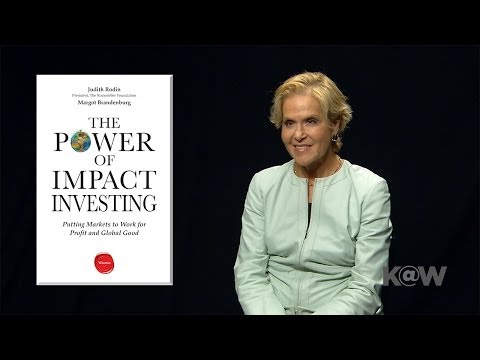
So this is -- it's big, it's growing. And the idea is, if you can leverage private capital for public gain, this is a way to create impact at a large scale that's not possible with just government alone or business alone or nonprofit alone. - So Katherine then, and we'll show the book right here, why now? Why is -- what's the importance of doing this book at this moment? Katherine Klein: So we were excited to do this book at this moment, given interest in business schools and among the public in impact investing and a real -- we wanted a how to book that was not just a user's manual, but that had a lot of practical how to knowledge, but also rigorous -- you know, the academic backed research to really guide people in understanding impact
investing. We see just a huge number of students at Wharton, both undergrads and MBA students, who want to get into the field. So the ability to provide some, you know, how to from every stage of the process. What is this thing? How do you get started as an investor? How do you do due diligence? How do you assess impact, etcetera, etcetera, was part of the story we wanted to tell here. - So then Tyler, when somebody is considering this as a component, what are some of the things that they should think about first? - So it depends on if you're talking about on the investor side or the -- - Okay, let's start with the investor side. - In terms of running a fund or investing in a fund? - Investing in a fund.
- So it depends a little bit on where you want to make your impact. So if you look at different impact investment funds, like any fund, they're going to have a different thesis. And so there's going to be some that are focused on environment, financial inclusion, some that are focused on biotech, med tech, hard tech, a lot of AI stuff coming up as well. And you should also think about the geography where you want to make impact. So what is the functional area? Where is the geography? And then what stage of company do you want to try and support? So this could be right down to pre seeds. So I'm a founding partner in an investment fund called Critical Venture Partners, and we do pre seed impact investing. But you
could also look all the way up to growth equity. Maybe you want to look at the models and the firms that are performing really well, and then allocate capital to help them grow and make a real dent in the world. - Are you seeing firms or funds that maybe haven't gone down the impact road that are now seeing this as something that they want to look at and maybe build into their structure as a company? - Oh, sure. Yeah, we have traditional funds that are opening up impact sleeves. So you can see that in VC, private equity, you can see it in larger retail products. Once you start to get into the larger retail stuff, it starts to get a little bit fuzzy. What is ESG investing and what is impact investing? And those are
actually different. So ESG would focus on the internal operations of the company, make sure it has good environmental performance, social impact, and governance, whereas impact investing is much more about the outputs that the company is creating. So you specifically target companies that, through their productive activities, are making positive change in the world. - So I noticed that in the book, Bobby Turner wrote the foreword. I had a chance to meet him a few years ago at the Global Forum down in Miami. If you can, talk about how he is such a great example of what impact investing can kind of do for communities and for companies as well. - So Bobby, who's a Wharton alum and just a real leader
in impact investing, tells his story of, you know, graduating from Wharton, very focused on, let me make a lot of money, then -- and as he tells it, it's like, "Yeah, I was just successful, and I wasn't satisfied. It wasn't meaningful to me. I wanted to have more positive impact in the world. And so I --" Bobby tells the story. "I, Bobby, got more and more involved in philanthropy, and ultimately, more and more frustrated with philanthropy. I wanted --" you know, he would say he wanted to make a bigger difference, and thought that he could do so by marshaling investment capital, which was his expertise, and figuring out, how can we use investment capital to propel positive impact and positive financial returns.
He's done it with his particular expertise, with a focus on real estate and real estate development. I think one of the things that Bobby does really well, and it is a sort of story, a useful story, and insight about impact investing, is his firm brings together people who have a lot of content expertise on the problems they want to solve. How do we help communities? How do we create more affordable housing? How do we create more workforce housing? You know, there's just tremendous expertise that Bobby's firm is trying to bring to bear on their investment strategy so they can make strong financial returns and real impact. So that's a short overview of what I would say Bobby's doing, and
that's generalizable to a lot of impact investing. - So in terms of kind of the nuts and bolts of the book, Katherine mentioned there are so many different components to it, one of the things that I picked out that I wanted to talk to you about is you talk about the component of opportunity. And certainly there are so many opportunities out there kind of in this realm right now, and you do have to take the time about looking at and picking the right opportunity, don't you? - Oh, 100 percent. So it's like any type of investing. There's going to be way more companies, way more opportunities that you could support than you actually can. And so you have to be really, really focused in terms of, where do you want to look, and then
how are you going to recognize quality? And when you're talking about especially early stage impact investing, which is what the book focuses on, this gets really tricky, because not only do you have to project out on financial metrics like any other investor would, you also need to try and project out on social impact, and that gets really, really tricky. So we have some frameworks in the book that try and help with that, but to actually do good social impact measurement and good social impact projection, this is something that is really tough, and it's actually really costly. So a big challenge for the field going forward. - I think we talked about it a few years ago, but it is just a unique kind of balance that, for a long time people wondered, you
know, impact investing, it's doing good, but can it still be profitable? And certainly we know that it is the case. - It is the case. You can certainly -- what I would say is, yes, you can do good, and you can be profitable. It's certainly not lockstep and guaranteed. It's certainly not guaranteed. And you know, as companies get investment, and you know, you talked about sort of non impact investors getting into impact investing as an interesting -- creates interesting tensions. And at every stage of a company's growth, there are likely to be, not always, but there are likely to be questions of, should we do this? Will it be more profitable for us to do this? And will it sacrifice impact or not? So
you know, yeah, it's challenging. It's challenging to do both well, but we see many examples of companies and firms doing both well. - Yeah, I was going to say that there's a concept in impact investing, it's called colinearity of financial returns and impact. And so in academics and statistics, if things are colinear, they vary completely with each other. So one is almost a function of the other. And so if you look at some impact investing opportunities, there will be high colinearity. So think about a company that has designed something that abates carbon and turns it into methane gas that you can use as a clean fuel for the shipping industry. The more that
company grows, the more money they make, the more impact they make. And on the flip side, you could think of something like micro finance, where there are some micro finance banks that make a lot of money, and there's other ones where they're trying to help the poorest of the poor, women, rural populations, and that becomes really hard. There's financial trade offs that associate with that. And that's a trickier place to try and make impact as well as return. - So how much growth are we seeing in terms of just the different types of avenues that are kind of coming into opportunity and impact investing? It seems like with the growth that we've seen, in terms of the focus on environment, on our culture, on
society, that there are new avenues that are popping up almost every year at this point. - I think that's true, and we've certainly seen growth. I mean, this is a challenging period in the United States as there's some sense of priority shifting, and how that plays out for impact investing, I don't think we know yet, right? It could drive more capital with the impact investing. I want to make an impact, I like this opportunity, I'm not seeing so many other opportunities. You know, maybe government is actually doing less, and we ought to really double down on, you know, what private capital can do. Or it may, you know, sway people to say, "Well, impact, I don't know."
So I don't know, that would be my prediction. It's hard to predict, which is no prediction. - It's tough, right? Like, you can price risk, you can't price uncertainty. It's just inherently unknowable. So I don't know. We'll see where it goes. I think, like almost anything, the change will make some opportunities more attractive and some less attractive. So there'll probably be a little bit of reordering in terms of where the money is going, and unclear if we'll see growth in the field or if we might see a little shrink. But I think it definitely puts a point of emphasis on why this is so important right now, you know? If we're going through a time where the government's retrenching its
efforts to do some of this stuff, how can we bring private capital to the table to step into the breach and hopefully do stuff that's innovative, efficient, and impactful? - The only other thing I would add is, while impact investing is a newer term over the last almost two decades, 20 years, there has been a long, long history of thinking about social responsibility and the ethics of capital. You know, that -- for decades, maybe even centuries. So this isn't a new -- I don't think that this consideration is going anywhere. Investors are always going to think, "Am I comfortable with where my money's going?" - What do you hope that who people read this book will take away from?
What are the key things you think are important to touch on here? - You know, I think the shortest answer to that is, I hope people who read this book think impact investing is possible, and understand that it's challenging. It is not easy. It takes a lot of thought. It is a complex process to balance and prioritize both impact and financial performance, but it is possible. So that would be my short. - Tyler? - Yeah, I think it's the same thing. The only way this field is going to continue to grow is if we have a pipeline of smart, motivated young people who are choosing this as a career, and to the extent that we can help them understand the blocking and tackling of doing this stuff in practice and make
them good candidates as they go into funds, or as they start their own, or even go into industry and try and do this stuff, all the better. - Well, thank you both for coming in today, Katherine Klein and Tyler Wry, Co-Faculty Directors of the Impact Investing Research Lab here at Wharton. And as we mentioned, the book that they have out right now,<i> An Introduction to Early Stage</i> <i>Impact Investing.</i> Thank you for listening to the Ripple Effect. We hope you found this episode informative and engaging. Don't forget to subscribe and leave us a review so that we can continue to bring you the best insight from the Wharton School.