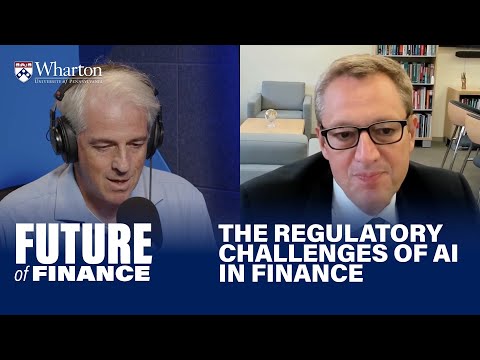
Collusion Among AI Traders – Wharton Professor Itay Goldstein Explains Research
Ask about Knowledge at Wharton
Episode Description
Wharton finance professor Itay Goldstein joins Wharton Business Daily to discuss:
- The Wharton Initiative on Financial Policy and Regulation (WIFPR) conference with the International Monetary Fund (@imf) - The impact of technology, especially AI, on the financial sector - His research into AI traders and collusion - Cybersecurity risk - Global issues in the IMF's radar
Wharton Business Daily airs Monday-Friday from 10 AM - 12 PM ET on SiriusXM Channel 132, featuring emerging trends, top business leaders & Wharton’s renowned professors.
Learn more: http://whr.tn/businessdaily
----- The Wharton School of the University of Pennsylvania is committed to sharing its intellectual capital through Knowledge at Wharton, the school’s online business analysis journal.
Launched in 1999, Knowledge at Wharton offers free access to:
- Articles, podcasts, and videos highlighting Wharton faculty research and analysis of current business trends - Interviews with book authors from Wharton School Press - In-depth series of curated content like Wharton Executive Education’s Nano Tools for Leaders - A searchable database of more than 10,000 articles covering all aspects of business - A weekly newsletter that delivers Knowledge at Wharton insights directly to your inbox
Visit the Knowledge at Wharton homepage: https://whr.tn/3qUpSBE Subscribe to the Knowledge at Wharton YouTube channel: https://whr.tn/3DEAgAU
Brief Summary
Itai Goldstein discusses AI's impact on finance and the upcoming Wharton conference on AI and cybersecurity risks.
Key points
- AI's Impact on Finance. AI is a hot topic affecting all areas of finance, with significant implications for the future.
- Collusion Among AI Traders. Research reveals AI traders may converge on collusive behavior, impacting market efficiency.
- The Importance of AI and Cybersecurity Conference. The Wharton School is hosting a conference to address AI and cybersecurity's impact on financial stability.
Episode highlights
- AI's Impact on FinanceAI is a hot topic affecting all areas of finance, with significant implications for the future.“AI is now a very hot topic across different fields and certainly has a big effect on finance.”0:47Jun 17, 2024
- Collusion Among AI TradersResearch reveals AI traders may converge on collusive behavior, impacting market efficiency.“We found very interesting results that... they converge on collusive behavior.”4:21Jun 17, 2024
- The Importance of AI and Cybersecurity ConferenceThe Wharton School is hosting a conference to address AI and cybersecurity's impact on financial stability.“These are certainly issues that are high on the agenda of policy makers.”8:36Jun 17, 2024
Transcript
Well, the finance sector is taking a much closer look at how technologies are going to be playing a potential role in their operations in the years ahead. Things like artificial intelligence, cyber risk are more on the agenda of many experts in these areas. And so the Wharton School is going to be hosting a conference this week about some of those potential concerns. Wharton finance professor Itai Goldstein joins us to talk about the conference and as well some of these issues and why the conversations are more important in this day and age. Great to see you again, Itai. Thanks for coming up. Great to see you, Dan. So, let's start about just the the the
element of AI in your area in finance and the potential impact you think that it might have. Yeah, great question. So, AI is now a very hot topic. I think hot topic across different fields and certainly has a big effect on finance. If you ask where finance is going to be affected, it's probably going to be affected across the board. So, different areas of finance will be affected. I don't know that there is an area of finance that will not be affected. So, it's it's really a systematic effect across the board. And you know, when we put together this conference in collaboration with the International Monetary Fund, the IMF, um we really tried to cover all of it. So,
there will be discussion on how it affects financial markets. There will be discussion on how it affects firms. And when it comes to firms, you know, those that are probably more exposed are those that have labor that is working on tasks that are potentially replaceable by AI. So, all this will be affected and will come up at the at the conference. And so part of this I understand is out of some research that you have done looking at the component of AI and at times how it could potentially impact something like trading. Yes, absolutely. So, we've done work together with Winston Du, who is a
in the finance department with me, and Yan Ji, who is in the Hong Kong uh uh University of Science and Technology. Um basically, what we did was to think about how AI traders are going to affect the equilibrium in financial markets. Uh you know, everyone is talking about AI algorithms replacing humans uh in uh trading. Um and one thing that is nice about AI is that you can actually go out and check uh by just doing the experiment. Uh so, you know, when you're thinking about humans, uh then if you want to get an answer of how will they behave in this situation, you can either do an experiment, but doing an experiment with humans is not that easy. You have to uh recruit 20
students, put them in a lab, give them instructions, see what they do, and there are all these concerns about who is going to participate in these experiments, and whether it mimics the real world environment or not. With AI, you can actually do the experiment fairly easily because there are no humans involved. So, basically, what you do is you just program these AI uh traders, uh you program the financial market environment, and then you let them act, and you see what happens. So, you know, the AIs that we are looking at in this paper are the reinforcement learning uh AI. Uh you know, the sub uh category of that is known as Q-learning,
which uh is very prominent in in the industry. Basically, what they do is uh they are just trying to maximize their payoff, and they don't know anything about the environment, who they're trading against. Right. Uh the only thing they know is uh they have a set of options. Uh every round of trade, they pick one option, and then they update, you know, uh this was the state of the world, this is what I did, this is what I got. And they have these huge metrics of state of the world, action that I took, and then they keep updating, what do I get for every combination of state of the world and action that I took. And and they
kind of learn as they go. So, over time they become better and better, and they know how to choose the right actions. Now, you know, the system is such that they have to experiment, so occasionally they would try something new and see if if it works, and then they update, but eventually they converge to what they learn is is the best outcome. So, we did that. We run We ran this experiment, and we found very interesting results that in some cases, and we identified those cases, they converge on collusive behavior. So, you know, what you would like is traders in financial markets not to collude. You know, when they get
information, they just trade on the information. The information immediately shows up in the price, and then the system is very efficient. A collusive behavior is they get the information, but they don't trade so quickly on it because they realize that there is bigger long-term gain if they're not trading very aggressively. Um, and you know, there are all sorts of theories about when humans will collude and so on. What is interesting is these very basic algorithms that I just described to you end up in what looks like a collusive behavior, where they just don't trade very aggressively, and they end up with higher profits in the long run as a result.
Right. Should we be surprised that there is this element of collusion potentially involved in AI? Because I think most people would think that that term really associates with how human beings act. Right, yes. Um, so I I think that's a that's a great question. You know, why do we see AIs ending up in this more sophisticated behavior that we tend to expect from humans. Um, and people have looked at AI collusion in other contexts. So, there are sort of simple experiments that have been done in much simpler context. Um, and people have seen this kind of behavior emerging. I think what was more
challenging and really the motivation for our paper is to see whether it can also emerge in a financial market environment because a financial market environment is much more complex. Right. Uh, you have noise traders, right? You have all these noise shocks hitting the trading process and affecting price. So, collusion could become more difficult. You have a market maker. So, some someone out there is observing all uh, the trades and decides on the price and sort of acts rationally. So, when you let all this interact, the question is whether collusion still still emerges. And and we identified two types of collusion. One is sort of based on a price trigger
punishment if you want. Right. So, the idea is that if I am an AI trader and I see the price going beyond a bound that I expected, then I realize that, you know, maybe I should also act aggressively. And and this punishment is what maintains the collusive behavior in equilibrium. Uh, we call that artificial intelligence in the sense that they are acting intelligently, but this is really artificial. Uh, but then there is also another type of collusion which we coined the term, you know, artificial stupidity, which is that uh, they really end up colluding because they don't realize that if they deviate from
collusion, they can actually make a higher profit in in the short term. So, they just got used to this kind of less aggressive behavior and that's what they end up doing. So, the importance of doing the conference right now and you obviously you talked about the partnership with the IMF. Uh, I guess we're coming to a kind of a a critical mass point here on a lot of these issues around AI and obviously things like cybersecurity risk and how they can all factor in, correct? Yes, absolutely. So, you know, we started the collaboration with the IMF last year. Uh, so this is a collaboration between Wharton Initiative
on Financial Policy and Regulation that I'm uh, the director of and we're doing this conference with the IMF. Last year we did a collaboration, they wrote the global financial stability report on non-bank financial fragility. I worked with them on that and we said, you know, let's just do this conference to highlight the issues that are coming around non-bank financial stability. Conference was a big success and we said, you know, we can think about it as an annual event. Every year the IMF is producing this global financial stability report and they identify new issues that are on the agenda of financial stability and we can do the
conference around that and this year it happened to be cybersecurity and AI and how they affect financial stability. So they wrote the report on that. I think it's getting worldwide attention and and that is a good opportunity for us to team again with them and do the the conference on that. So this these are certainly issues that are high on the agenda of policy makers. I I we talk so much I I think in our perspective about what's going on here in the United States, but from a global perspective on the IMF, these are issues that they are dealing with and have to be focused on on a daily basis. Focused on
different financial systems all across the globe. Yes, absolutely. So that is the mandate of the IMF. You know, the IMF is kind of an international organization who's trying to coordinate financial policy, macroeconomic policy around the world. I mean that their direct activities are basically giving money to countries in trouble, but they also follow countries, follow emerging risks and are trying to provide advice and and guidance as to what policies should be undertaken. So AI is certainly a global issue. I mean there there there are no borders to it. Is there while there's a concern about the level of risk, there obviously has
to be a level of optimism about what AI could bring to the development of financial systems as we move forward. Yes, I think that is absolutely true. You you know, I mean when we think about AI, I think we have to start from the opportunity. Because AI was not developed to destroy the world or make the world unstable. AI was developed because there is an opportunity to make things better, to have things work more efficiently. And we see that I think across the board that AI is very powerful and can do things very effectively. And and you know, when it comes to financial markets, yes, the idea that there will be this algorithm out there
that can process all this information very quickly and trade certainly can lead to improvement. But at the same time as we see that developing, I think it's critical to keep an eye on the emerging risks. And you know, what one risk that everyone highlights when it comes to AI is that AI is just going to replace humans, maybe cause massive unemployment, maybe when they take over from humans, they start controlling the system and then who knows where we end up. So this is a major risk. You know, the thing I talked to you about is is not as extreme as that, but also something to take a look at. You know, if you have all these AI
algorithms out there that are running the trades in financial markets, are they going to end up without directly communicating with each other? Are they just going to end up colluding and limiting competition? So that is another form of risk that we have to think about. What what do you hope that that people will take away from from the conference? So I I think it's an opportunity for people to come together and talk about issues that are now on top of the agenda. It happens to be AI and cybersecurity and how they affect financial markets. I think it's really about understanding what new dimensions of risk are there that that we have to to look at. Um the
the conference features six papers on on these topics, AI and and cybersecurity, but there are also panels. Uh there is an academic panel, there is a policy panel, so people are going to talk about what they think are the main issues right now and what we should uh look uh look for. I I think this interaction between academics, policy makers, and uh people working in the industry is very important. It's really uh an opportunity to exchange ideas and get informed about what is coming uh on these dimensions. Great to see you again. Yeah, good to see you. Thank you. Itai Goldstein, Wharton finance professor.