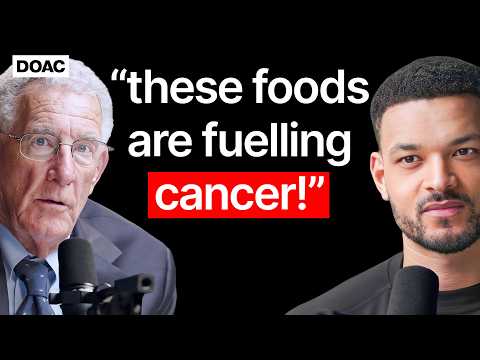
Leading Cancer Researcher: They’re Ignoring My Research, Cancer Patients Must Know This!
- Jul 16, 2026
- 1:45:37
- Full Episode
1,700 Americans will die from cancer today. 70 every single hour. Professor Thomas Seyfried says it doesn't have to be this way, and that mainstream oncology has misunderstood cancer for 100 years.
Thomas Seyfried, PhD, is a professor of biology at Boston College and one of the world's leading researchers on the metabolic origins of cancer. He is author of the book 'Cancer as a Metabolic Disease: On the Origin, Management, and Prevention of Cancer' and co-developer of the Glucose Ketone Index (GKI) and the “press-pulse” therapeutic strategy.
He explains:
◼ Why he believes cancer is a mitochondrial metabolic disease, not a genetic one
◼ Why cancer cells feed on two fuels and the strategy his team uses to starve tumors
◼ How a ketogenic diet lowers your GKI and makes chemo and immunotherapy work better
◼ The environmental drivers quietly damaging your mitochondria
◼ How his team is keeping glioblastoma patients alive for years, and why almost no patient is ever told this option exists
The views expressed are those of the guest, and this conversation is intended for general informational purposes only. This podcast and its associated materials should not be used as a substitute for professional medical advice, diagnosis, or treatment.
00:00:00 Intro 00:02:42 The New Discovery About Cancer 00:03:43 What Role Do Mitochondria Play in Cancer? 00:08:12 ATP & Fermentation: How Your Cells Make Energy 00:15:00 The Oncogenic Paradox Finally Explained 00:20:19 Ghost Mitochondria: Cancer Under the Microscope 00:25:19 Glucose & Glutamine: The Fuels That Feed Cancer 00:26:32 Why Do Children & Babies Get Cancer? 00:29:25 Why Wealthy Countries Have More Cancer 00:32:55 Is Cancer Genetic? 00:37:58 The Prescription: The Glucose Ketone Index 00:40:23 How Stress & Poor Sleep Fuel Cancer 00:44:54 What's Inside the Confidential Envelope? 00:45:58 The Patient Who Inspired the Discovery 00:50:25 Measuring Your Glucose Ketone Index Live 00:53:01 The 'Red Zone' Link To Cancer 00:58:02 The Man Who Survived Glioblastoma for 10 Years 00:58:55 Using the Keto Diet to Supercharge Chemo 01:07:32 The Experiment That Could Prove Cancer Isn't Genetic 01:08:30 1,700 Cancer Deaths a Day: Seyfried's Warning 01:13:41 Seyfried's Plan to End the Cancer Epidemic 01:16:25 What Foods You Should Actually Eat 01:21:58 Fasting Protocols & Hitting 'The Wall' 01:26:48 Hyperbaric Oxygen Therapy & Cancer 01:28:30 Microplastics & 'Forever Chemicals' 01:30:47 How Cancer Spreads: Metastasis Explained 01:37:27 The #1 Actionable Takeaway 01:39:45 Energy, Hope & Final Words
Follow Professor Thomas:
◼Instagram - https://link.thediaryofaceo.com/1MRuOwr
◼X - https://link.thediaryofaceo.com/DDF9xxr
◼Substack - https://link.thediaryofaceo.com/HKsGFcF
◼ Professor Seyfried's Biology Department - https://link.thediaryofaceo.com/HKwWhwD
◼ Foundation for Cancer Metabolic Therapies - https://link.thediaryofaceo.com/6Ehj3Hh
◼ Elizabeth Ann Weathers Breast Cancer Research Fund - https://link.thediaryofaceo.com/Bf10aHy
A message from Professor Seyfried: “If you would like to support research on the mitochondrial metabolic theory of cancer, please consider donating to our research. Please remember that no donation amount is too small or too large.”
The Diary Of A CEO:
◼ Join DOAC circle here - https://doaccircle.com/
◼ Buy The Diary Of A CEO book here - https://smarturl.it/DOACbook
◼ The 1% Diary is back - limited time only: https://bit.ly/3YFbJbt
◼ The Diary Of A CEO Conversation Cards: https://linkly.link/2hm7r
◼ Get email updates - https://bit.ly/diary-of-a-ceo-yt
◼ Follow Steven - https://g2ul0.app.link/gnGqL4IsKKb
Sponsors:
Wispr - Get 14 days of Wispr Flow for free at https://wisprflow.ai/steven Eight Sleep - http://eightsleep.com/steven use code STEVEN for up to $350 off. 30-day at-home trial. Free returns. Ekster Link: https://link.thediaryofaceo.com/GSNEWnm
Brief Summary
Professor Thomas Seaf Freed discusses mitochondrial health and its critical role in cancer management and prevention strategies.
Key points
- Call to Action. A plea for viewers to subscribe to the show to support ongoing discussions.
- The Role of Mitochondria. Mitochondria are central to understanding cancer and chronic diseases, affecting cell health.
- The Role of Glutamine. Glutamine is a crucial amino acid that fuels cancer cells.
- Lifestyle Factors and Cancer Risk. Modern lifestyle choices contribute to chronic diseases, including cancer.
- Chronic Stress and Disease. Chronic stress elevates blood sugar and contributes to systemic inflammation, leading to diseases.
- The Glucose Ketone Index Calculator. A groundbreaking tool to assess mitochondrial health through glucose and ketone levels.
Episode highlights
- Call to ActionA plea for viewers to subscribe to the show to support ongoing discussions.“If there was one simple free thing that you could do to help us...”2:17Jul 16, 2026
- The Role of MitochondriaMitochondria are central to understanding cancer and chronic diseases, affecting cell health.“Cancer is a mitochondrial metabolic disease.”3:23Jul 16, 2026
- The Role of GlutamineGlutamine is a crucial amino acid that fuels cancer cells.“It's the most abundant amino acid in our bloodstream.”25:05Jul 16, 2026
- Lifestyle Factors and Cancer RiskModern lifestyle choices contribute to chronic diseases, including cancer.“We are still paleolithic man and our biology has allowed us to store energy efficiently.”30:16Jul 16, 2026
- Chronic Stress and DiseaseChronic stress elevates blood sugar and contributes to systemic inflammation, leading to diseases.“Chronic stress creates an environment that damages our cells.”41:19Jul 16, 2026
- The Glucose Ketone Index CalculatorA groundbreaking tool to assess mitochondrial health through glucose and ketone levels.“This is a way to manage energy efficiency in the body.”45:31Jul 16, 2026
- Metabolic Therapy SuccessPablo Kelly lived 10 years with inoperable glioblastoma using metabolic therapy instead of conventional treatment.“He lived for 10 years and the tumor became operable.”58:31Jul 16, 2026
- Cancer Statistics 2026Projected cancer diagnoses and deaths in 2026 highlight the urgency of new approaches.“Approximately 626,000 Americans are expected to die from cancer in 2026.”1:10:47Jul 16, 2026