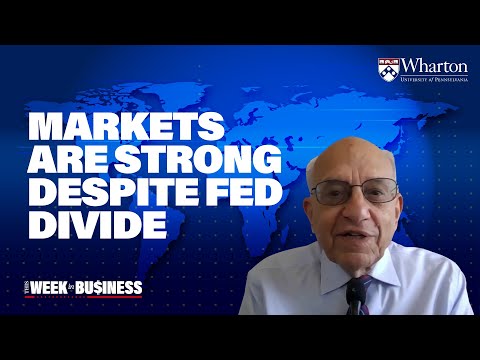
How Tariffs and Fed Policy Are Impacting the Stock Market
Ask about Knowledge at Wharton
Episode Description
ABOUT THE EPISODE The Wharton School Professor Itay Goldstein about the economic uncertainty stemming from recent U.S. tariff policies and potential threats to the Federal Reserve's independence. Goldstein explains how policy shifts—like fluctuating tariffs and discussions around replacing Fed Chair Jerome Powell—are impacting market volatility, investor anxiety, and financial stability. He outlines the importance of central bank independence and how both stock and bond markets are reacting. They also discuss possible best-case scenarios for future economic stability and growth.
#FederalReserve #EconomicPolicy #Tariffs #USEconomy #StockMarket #CentralBank #Fed ----- The Wharton School of the University of Pennsylvania is committed to sharing its intellectual capital through Knowledge at Wharton, the school’s online business analysis journal.
Launched in 1999, Knowledge at Wharton offers free access to:
- Articles, podcasts, and videos highlighting Wharton faculty research and analysis of current business trends - Interviews with book authors from Wharton School Press - In-depth series of curated content like Wharton Executive Education’s Nano Tools for Leaders - A searchable database of more than 10,000 articles covering all aspects of business - A weekly newsletter that delivers Knowledge at Wharton insights directly to your inbox
Visit the Knowledge at Wharton homepage: https://whr.tn/3qUpSBE Subscribe to the Knowledge at Wharton YouTube channel: https://whr.tn/3DEAgAU
Brief Summary
Wall Street faces uncertainty from tariffs and Fed independence, impacting market stability and economic outlook.
Key points
- Wall Street's Uncertain Journey. Wall Street faces significant uncertainty due to fluctuating tariffs and Fed independence discussions.
- Impact of Fed Independence. The potential removal of the Fed chairman raises concerns about market stability.
- Best Case Scenario for Markets. The best case is a return to stability with modest changes in policy.
Episode highlights
- Wall Street's Uncertain JourneyWall Street faces significant uncertainty due to fluctuating tariffs and Fed independence discussions.“The story of the last few months is a story about uncertainty.”0:41May 9, 2025
- Impact of Fed IndependenceThe potential removal of the Fed chairman raises concerns about market stability.“What if they’re all of a sudden going to change the rules of the game?”3:56May 9, 2025
- Best Case Scenario for MarketsThe best case is a return to stability with modest changes in policy.“This is not a stable path.”7:07May 9, 2025
Episode quotes
Transcript
Well, Wall Street has had a rocky road since the announcement of tariffs by the Trump administration. And while we are off the levels that we saw earlier this year, we also haven't seen a larger collapse either. So, what should we expect moving forward? Pleasure to be joined right now by it Goldstein who is a professor of finance here at the Wharton School. It great to talk as always. Thank you, sir. Great talking to you. You know, it's interesting. You know, we've talked so much about uncertainty and how the markets hate uncertainty. Well, certainly this has given it uh maybe one of the the biggest shocks of uncertainty we've seen in quite a while. Maybe going back Julie
the early days of the pandemic. Yes, this is absolutely true. I think the story of uh the last few months or I would say the the first 100 days of the administration is a story about uncertainty. Uh because it has been a rocky ride. you know tariffs are introduced and then they're paused and then they are reintroduced and then there is discussion about Fed independence and there is the possibility that is being floated about replacing the chairman of of the Fed uh and all these things are just creating a lot of uncertainty a lot of anxiety and I think that uh you know the fact that we see the stock market is generally
going down but also with a lot of volatility uh is certainly reacting to this uncertainty because one thing that we know from finance is that uh uncertainty and risk are having a big impact on the value of assets, the value of stocks, the value of other financial securities and and this is clearly on display here. You mentioned about uh the the conversation around Feder Powell. How has that impacted what we've seen on the markets? Obviously, as you said, we we saw those couple of days where, you know, there was a sharp decline in the markets. Uh but, you know, have the markets kind of settled in that it doesn't seem like there's going to be
any movement to remove Powell at this point? Yeah. You know, I mean, taking a step back here, I would say one of the things that most economists would agree on is it is important to have independence for the central bank. uh in the case of the US, you're talking about the Federal Reserve. We want that to be independent. Uh because we know a lot from economic theory, but also from historical episodes. Governments always have this temptation uh to create more money, to uh have uh inflation, to reduce rates, to sort of have looser conditions that would help uh economic activity. But but this is a shortterm bias because this is creating
a boost in the short term uh but then uh as uh the the market as the economy uh gets used to it uh then uh the effect is subsiding and in the long run this is really damaging because what happens in the end of the day is you are left with the inflation and you don't really have any of the uh positive uh economic effects. So, so the reaction to it uh over time was really to have this uh central bank who is independent and is going to try to resist the temptation. If the government is trying to uh create looser conditions, the central bank will say no, you know, we are worried about inflation, so we are going to tighten conditions when we see that inflation is
is picking up. Um and and this is very important because then you have the restraint from the central bank and you're not tempted to fall into this trap of short-term uh economic uh stimulus. Now, when you see uh talks that are being floated about uh reducing the independence of the central bank and potentially even firing the chairman of the the Fed, that is creating a lot of anxiety because that is kind of saying, you know, what if they're all of a sudden going to change the rules of the game and we are not going to be in this uh system that has more uh caution and responsibility. Uh what is that going to do? That's going to be bad for the
economy going forward. and that is creating a lot of anxiety. So I think we saw a lot of that. I think at the end of the day the administration so far got the message from the market that it will not be a good idea to try to replace the chairman of the Fed at this point and they said they're not going to they're not going to do it. But in the end of the day, when you're thinking about it, there is still a lot of uh uh uncertainty going forward about just how independent uh the the Fed is going to be, who is going to replace uh Powell uh when the time comes and what will it look like at that point? And is the administration then also getting the message in terms of the level of tariffs
and and is there somewhat of an expectation by those in and around Wall Street that we may see tariffs at some point longer term? Maybe it's 10% whatever that number is, but a lot lower than obviously what the president has talked about uh you know so far. And maybe are they starting to bake that into what we see you know in terms of the results on Wall Street? I think so. Yes. I think the general expectation is that the message from the market is going to be loud and clear and that ultimately this is going to rain in the administration and they will not go in the wildest scenarios of very high tariffs as uh they were talking about
for for a while. uh you know when you're thinking about the response of the market uh you're thinking about there is the stock market and I think for a while the the administration was saying okay we can live with uh low stock prices for a while because this is just the investors this is not uh sort of the the simple uh uh people the working class um but uh when you started seeing a reaction from the bond market I think this was a lot more uh devastating uh because once you see that the bond market is uh reacting. You basically risk a very major financial crisis. You risk the ability of uh the US government to fund its debt and all these things can have uh much more severe
implications and when this came I think this uh really uh generated some understanding that you know we cannot really persist on this path for much longer. So what's the best case scenario then to play out that uh maybe serves the purposes of what the administration is trying to do but also kind of leads us on a path to to the growth that we I think expect to see in Wall Street uh moving forward. That's uh that's a good question. Uh uh I I would say the the best case scenario is that uh the administration uh understands that uh the path of uh you know reduced uh independence of the Fed and uh increase tariffs this is not a viable path. This is not a stable path
and they're just going to uh walk it back uh to to a large extent. uh maybe have some modest uh changes but certainly not changes that they were discussing and that this is all going to be uh built back in to to asset prices and and we will see uh more come uh in in the market going forward. This is probably the the best the best case uh scenario. Whether this is going to pan out or not, I don't know. I mean that there there seems to be uh some taste for some uh volatility and some uncertainty and we see new measures and new announcements coming out every day. Um so whether we will see the best case scenario or not uh it remains to be seen.
Either thanks very much for your time today. Okay, thank you very much. Ei Goldstein who's professor of finance and professor of economics here at the Wharton School.